How the Average American Wastes $273/Month on Subscriptions (And How to Fix It)
Table of Contents
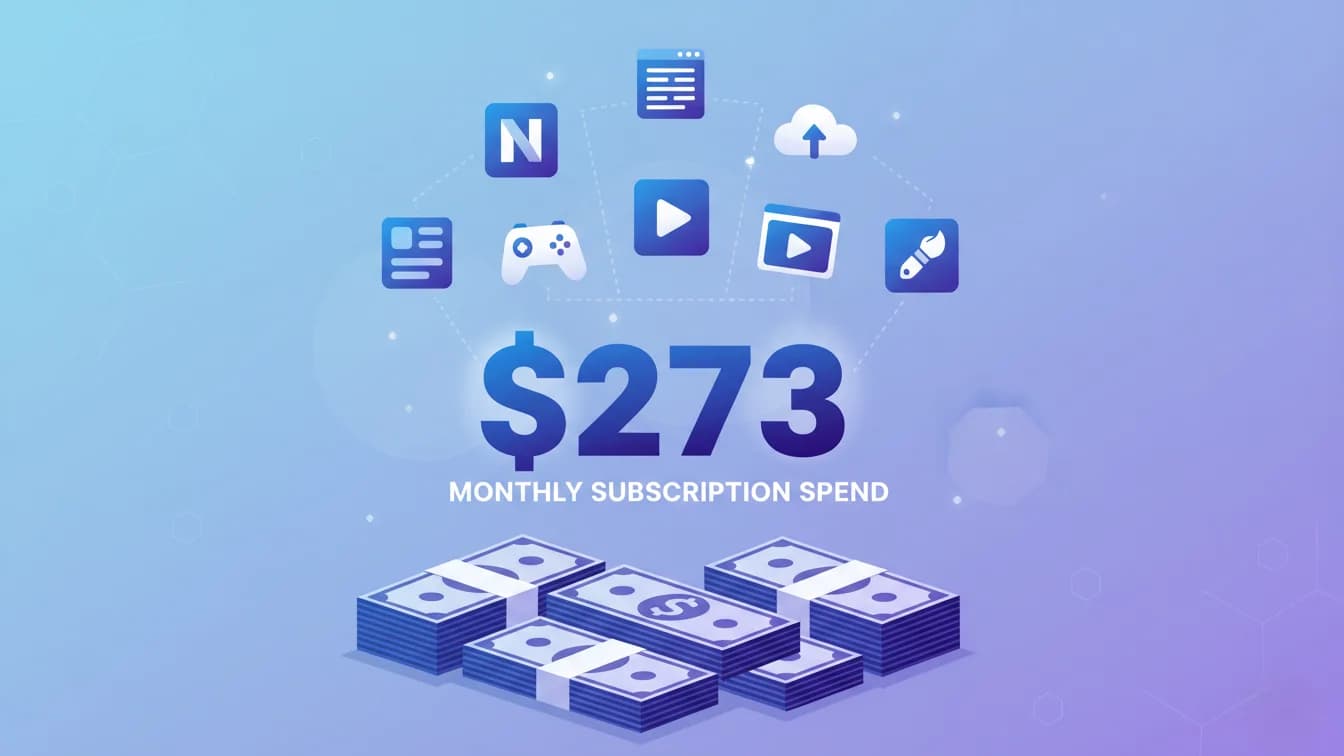
If you're like most Americans, you're hemorrhaging money on subscriptions—and you probably don't even realize it. A 2024 study by C+R Research found that Americans spend an average of $273 per month on subscription services, yet when asked to estimate their monthly subscription spending, most guessed around $111. That's a staggering 146% underestimation.
This "subscription blind spot" is costing the average household over $3,200 per year in expenses they barely notice. But here's the good news: awareness is the first step to taking control, and with the right strategy, you can cut your subscription spending by 30-50% without sacrificing the services you actually value.
The Hard Numbers: America's Subscription Spending Crisis
Let's start with the data that should wake everyone up:
- $273 per month - The average American's actual subscription spending (C+R Research, 2024)
- $111 per month - What people think they spend on subscriptions
- $162 monthly gap - The "invisible" spending most people miss
- 42% - Percentage of consumers who have forgotten about at least one subscription they're paying for
- $219 - Average annual waste on unused subscriptions per household
- 71% - Americans who say they want to cut subscription spending
Real-World Impact: If you're spending $273/month on subscriptions when you only need $150 worth, that's $1,476 per year you could be investing, saving for a down payment, or using to pay down debt. Over 10 years at a 7% return, that's over $20,000.
Breaking Down Where Your Money Goes
Not all subscriptions are created equal. Here's how the average American's $273 monthly spending typically breaks down:
Streaming Services: $48/month average
The average household now subscribes to 4.7 streaming services. With prices ranging from $6.99 (Hulu with ads) to $19.99 (HBO Max), it's easy to see how this adds up. Many households maintain subscriptions to:
- Netflix ($15.49 - $22.99)
- Disney+ ($7.99 - $13.99)
- Hulu ($7.99 - $17.99)
- Amazon Prime Video (included with $14.99 Prime)
- HBO Max ($15.99)
- Apple TV+ ($9.99)
Music Streaming: $11/month average
Whether it's Spotify Premium ($11.99), Apple Music ($10.99), or YouTube Music ($10.99), most Americans pay for at least one music streaming service. Some households unknowingly maintain multiple subscriptions.
Software & Productivity Tools: $67/month average
This is where spending can spiral out of control, especially for remote workers and freelancers:
- Cloud storage (Google One, Dropbox, iCloud+): $5-20/month
- Microsoft 365 or Google Workspace: $6.99-12.99/month
- Creative software (Adobe Creative Cloud, Canva Pro): $9.99-54.99/month
- Password managers: $2.99-7.99/month
- VPN services: $5-13/month
Fitness & Wellness: $29/month average
- Gym memberships: $10-80/month
- Fitness apps (Peloton, Apple Fitness+, Strava): $9.99-44/month
- Meditation apps (Calm, Headspace): $14.99/month
- Nutrition tracking (MyFitnessPal Premium): $9.99/month
Gaming & Entertainment: $32/month average
- Xbox Game Pass Ultimate: $16.99/month
- PlayStation Plus: $9.99-17.99/month
- Nintendo Switch Online: $3.99-7.99/month
- Mobile game subscriptions: Variable
News, Learning & Books: $24/month average
- Audible: $14.95/month
- Kindle Unlimited: $11.99/month
- News subscriptions (NY Times, WSJ, Washington Post): $4-40/month
- Online learning (MasterClass, Coursera, Udemy): $15-39/month
Food & Lifestyle: $42/month average
- Meal kits (HelloFresh, Blue Apron): $60-140/week
- Food delivery passes (DoorDash, Uber Eats): $9.99/month
- Wine/coffee clubs: $25-75/month
- Pet services (BarkBox, PetPlate): $20-50/month
Other Subscriptions: $20/month average
This includes everything from dating apps to professional memberships to auto-renewing charitable donations.
The Generational Divide: Who Spends the Most?
Subscription spending varies significantly by age group, revealing different consumption patterns and priorities:
Gen Z (18-27): $214/month average
Despite earning less, Gen Z spends heavily on:
- Gaming subscriptions (highest of any generation)
- Social media premium features (TikTok, Snapchat+)
- Multiple streaming services (5.2 average)
- Creator platform subscriptions (Patreon, OnlyFans, Discord)
Key insight: Gen Z has the highest number of active subscriptions (12.3 average) but often chooses lower-priced tiers.
Millennials (28-43): $301/month average
Millennials are the highest-spending generation, driven by:
- Professional software for remote work
- Family streaming accounts
- Meal kit and convenience services
- Fitness and wellness apps
- Children's educational and entertainment apps
Key insight: Millennials often maintain duplicate subscriptions within their household and have the lowest awareness of total spending.
Gen X (44-59): $282/month average
Gen X spending focuses on:
- Premium news and journalism subscriptions
- Home security and monitoring services
- Professional development platforms
- Wine and gourmet food clubs
Key insight: Gen X has the highest percentage of "forgotten" subscriptions at 47%.
Baby Boomers (60+): $179/month average
Boomers spend on fewer but often pricier subscriptions:
- Premium cable/streaming bundles
- Medical alert services
- Magazine and newspaper subscriptions
- Audiobook services
Key insight: Boomers have the most accurate estimate of their spending, underestimating by only 18%.
Why We Consistently Underestimate Our Spending
There are several psychological and practical reasons why we fail to track subscription costs accurately:
1. The "Small Purchase" Illusion
When you see "$9.99/month," your brain doesn't automatically calculate the annual cost of $120. Each subscription feels trivial in isolation, but together they add up to thousands per year.
2. Subscription Sprawl Across Payment Methods
Your Netflix might be on one credit card, Spotify charges your debit card, Apple subscriptions come through your phone bill, and Amazon charges are buried in your Prime account. This fragmentation makes it nearly impossible to see the full picture.
3. Annual Subscriptions That Surprise You
When Amazon Prime or your antivirus software charges you $139 once a year, you forget it exists for 364 days. Then the charge hits and you're shocked all over again.
4. The Free Trial Trap
42% of consumers report being charged for a free trial they forgot to cancel. These trials are designed with dark patterns—requiring credit card information upfront and making cancellation difficult.
5. App Store and Platform Subscriptions
Subscriptions made through Apple App Store or Google Play are particularly easy to forget because they're bundled into a single charge and hidden in settings menus.
The 4-Step Audit: Eliminate Wasteful Spending
Ready to take control? Here's the systematic approach that has helped thousands of people cut their subscription spending by 30-50%:
Step 1: The Complete Inventory (Week 1)
Goal: Discover every single subscription you're paying for.
Action items:
- Review 3 months of credit card and bank statements
- Check your PayPal transaction history
- Review Apple App Store subscriptions (Settings → Your Name → Subscriptions)
- Review Google Play subscriptions (Play Store → Menu → Subscriptions)
- Search your email for "subscription," "renewal," "membership," and "auto-renew"
- Check Amazon subscriptions (Account → Memberships & Subscriptions)
Create a master list with:
- Service name
- Monthly cost (convert annual to monthly for comparison)
- Billing date
- Renewal type (monthly/annual)
- Payment method
Pro Tip: Use SubBuddy to centralize all this information in one dashboard. You'll see your total monthly and annual spending instantly, plus get reminders before renewals.
Step 2: The Value Assessment (Week 2)
Goal: Determine which subscriptions genuinely add value to your life.
For each subscription, ask:
- Usage frequency: When's the last time I used this? Daily? Weekly? Monthly? Never?
- Replaceability: Could I get this value elsewhere for less or free?
- Cost per use: If I use Netflix 20 times a month, that's $0.75 per use. If I use my meditation app once a month, that's $14.99 per use.
- Overlap: Do I have multiple subscriptions that serve the same purpose?
Categorize each subscription:
- ✅ Essential: Use frequently, provides significant value, no good alternative
- ⚠️ Conditional: Useful but could be replaced, seasonal, or could use a cheaper tier
- ❌ Cut: Rarely use, forgotten about, or provides minimal value
Step 3: The Optimization (Week 3)
Goal: Reduce costs on subscriptions you're keeping.
Tactics for "Essential" subscriptions:
- Switch to annual billing: Most services offer 15-20% discounts for annual payment
- Downgrade tiers: Do you really need 4K streaming? The middle tier often provides 90% of the value at 60% of the cost
- Family plan sharing: Split costs with trusted family or friends (within terms of service)
- Bundle deals: Apple One, Disney Bundle, and Amazon Prime can save money if you use multiple services
- Student/military discounts: If eligible, many services offer 50% off
- Negotiate: Call and ask for retention deals, especially for SiriusXM, cable alternatives, and security services
Tactics for "Conditional" subscriptions:
- Seasonal rotation: Subscribe to HBO for 2 months when your show is airing, then cancel
- Pause memberships: Some gyms and services allow you to pause rather than cancel
- Use free alternatives: Spotify free with ads instead of Premium, free tiers of Canva, free cloud storage limits
Step 4: The Ongoing Management (Month 2+)
Goal: Maintain your optimized subscription portfolio and prevent future waste.
Create a subscription management system:
- Set calendar reminders 1 week before annual renewals
- Schedule a quarterly "subscription audit day" to review all services
- Use virtual credit card numbers for free trials so you can't be charged without action
- Implement a "one in, one out" rule: cancel an old subscription before adding a new one
SubBuddy Strategy: Our users save an average of $847 per year by using the dashboard to visualize spending and calendar to stay ahead of renewals. The analytics feature highlights which categories are eating your budget, making optimization decisions obvious.
Real-World Success Stories
Case Study 1: Sarah, 34, Marketing Manager
Starting point: $312/month across 17 subscriptions
After audit: $142/month across 9 subscriptions
Annual savings: $2,040
What she cut:
- Canceled Adobe Creative Cloud ($54.99/month) and switched to Canva Pro ($12.99/month) for 90% of her needs
- Eliminated 3 streaming services she watched less than once a month
- Canceled HelloFresh ($120/week) and meal plans on her own
- Downgraded iCloud storage from 2TB to 200GB
What she optimized:
- Switched Spotify to annual billing (saving $24/year)
- Joined a family plan for YouTube Premium (saving $72/year)
- Negotiated her gym membership down by $15/month
Case Study 2: Mike and Jennifer, 42 and 40, Parents of Two
Starting point: $387/month across 23 subscriptions
After audit: $198/month across 12 subscriptions
Annual savings: $2,268
What they discovered:
- They had 6 streaming services but only regularly used 2
- Both had individual Spotify accounts instead of a family plan
- They were paying for Dropbox and Google One with overlapping storage
- Mike had a gym membership he hadn't used in 8 months
- Three children's apps were still auto-renewing despite the kids outgrowing them
Their strategy:
- Adopted a "streaming rotation" - keep 2 services, rotate a 3rd based on what's new
- Consolidated to one family cloud storage solution
- Set up SubBuddy to alert them 1 week before any renewal
- Implemented a rule: new subscriptions require canceling an existing one
Case Study 3: David, 28, Freelance Designer
Starting point: $294/month across 14 subscriptions
After audit: $167/month across 10 subscriptions
Annual savings: $1,524
His unique challenge: As a freelancer, he needed professional tools but was paying for more than necessary.
His optimization:
- Switched from monthly Adobe subscription to annual (saved $120/year)
- Discovered his client workload only needed Adobe 8 months per year - now subscribes seasonally
- Canceled LinkedIn Premium ($29.99/month) after realizing he never used the features
- Combined his personal and business Notion accounts
- Switched from Dropbox Business to personal plan (his real usage was under 100GB)
The Subscription Management Checklist
Print this out and conduct your audit:
☐ Streaming & Entertainment
- Video streaming (Netflix, Hulu, Disney+, HBO Max, etc.)
- Music streaming (Spotify, Apple Music, YouTube Music, etc.)
- Gaming (Xbox, PlayStation, Nintendo, Steam, etc.)
- Audiobooks (Audible, Libro.fm, etc.)
☐ Software & Productivity
- Cloud storage (Google One, Dropbox, iCloud+, OneDrive, etc.)
- Office suites (Microsoft 365, Google Workspace, etc.)
- Creative software (Adobe, Canva, Final Cut, etc.)
- Project management (Notion, Asana, Monday.com, etc.)
- Password managers (1Password, LastPass, Dashlane, etc.)
- VPN services (NordVPN, ExpressVPN, etc.)
☐ Health & Fitness
- Gym memberships
- Fitness apps (Peloton, Apple Fitness+, Strava Premium, etc.)
- Meditation & wellness (Calm, Headspace, etc.)
- Nutrition tracking (MyFitnessPal, Noom, etc.)
☐ News & Learning
- News subscriptions (NY Times, WSJ, etc.)
- Magazine subscriptions
- Online courses (MasterClass, Coursera, Skillshare, etc.)
- Kindle Unlimited
☐ Food & Lifestyle
- Meal kits (HelloFresh, Blue Apron, etc.)
- Delivery services (DashPass, Uber Eats Pass, etc.)
- Coffee/wine clubs
- Amazon Prime & Subscribe & Save items
☐ Other Services
- Dating apps (Tinder, Bumble, Hinge premium, etc.)
- Pet services (BarkBox, Chewy Autoship, etc.)
- Photo storage & printing (Shutterfly, Google Photos, etc.)
- Home security & monitoring
- Professional memberships
- Donation subscriptions
Tools to Help You Track and Manage
While you can track subscriptions manually with a spreadsheet, dedicated tools make the process much easier:
SubBuddy (Our Solution)
We built SubBuddy specifically to solve the subscription management problem with:
- Clear dashboard: See all your subscriptions and total spending at a glance
- Visual calendar: Never be surprised by a renewal date again
- Smart analytics: Understand where your money is going with category breakdowns and spending trends
- Renewal alerts: Get notified before you're charged so you can evaluate if you want to keep the service
- Trial tracking: Add free trials with end dates so you remember to cancel before being charged
- AI optimization (Premium): Get personalized recommendations for reducing your spending
Start with our 1-month free trial, or grab our lifetime deal to never worry about subscription management again.
Other Options
- Bank apps: Many banks now categorize recurring charges, though they can't predict future renewals
- Credit card tools: Some credit cards offer subscription tracking features
- Spreadsheets: Free but requires manual updates and offers no automation
The Psychology of Saying "No"
Even after discovering wasteful subscriptions, many people struggle to cancel. Here's how to overcome the mental barriers:
Combat FOMO (Fear of Missing Out)
Worried you'll miss something if you cancel? Remember:
- Most services let you re-subscribe anytime
- Content will still be there in a few months
- You can binge-watch when you resubscribe for one month
Overcome the Sunk Cost Fallacy
"But I've been a member for 3 years!" doesn't mean you should keep paying. Past spending is gone. The only question that matters: "Is this worth the cost going forward?"
Reject "Just in Case" Thinking
"I might need Adobe Illustrator someday" is costing you $54.99/month right now. When "someday" actually arrives, you can subscribe then.
Calculate Opportunity Cost
Every dollar on a subscription you don't use is a dollar not going toward something you value. That $50/month you're wasting could be:
- An extra $600 toward your emergency fund each year
- Two nice dinners out per month
- Funding a hobby you actually enjoy
- $8,000 invested over 10 years
Preventing Future Subscription Creep
Once you've optimized your subscriptions, protect your progress with these ongoing habits:
The New Subscription Protocol
Before signing up for anything new, ask yourself:
- Can I try it free first? Use free tiers before committing to paid
- Do I need it monthly or occasionally? Consider subscribing for one month when you need it
- What will I cancel to make room? One in, one out rule
- Am I signing up because of a discount? A deal on something you don't need is still wasted money
- Have I added it to my tracker? Never subscribe without adding to SubBuddy immediately
The Free Trial Strategy
- Use a virtual credit card number that you can cancel instantly
- Set calendar reminders 2 days before trial ends
- Take screenshots of cancellation instructions when you sign up
- Treat the trial end date as the decision date, not the start date
The Quarterly Review
Schedule a recurring calendar event every 3 months to:
- Review all active subscriptions
- Check for price increases
- Assess usage of each service
- Look for new bundle deals or better alternatives
- Update your SubBuddy dashboard
Taking Action Today
The gap between your estimated and actual subscription spending represents money that's disappearing from your life with nothing to show for it. But unlike other financial problems, this one is completely fixable—and you can start right now.
Here's your immediate action plan:
- Today: Create a free SubBuddy account and add the 5 subscriptions you can remember off the top of your head
- This week: Complete the full subscription audit using the checklist above
- Next week: Cancel or downgrade at least 3 subscriptions you identified as wasteful
- This month: Set up recurring calendar reminders for your quarterly review
Remember, you don't have to eliminate all subscriptions—many provide genuine value. The goal is consciousness. When you know exactly what you're paying for and why, you're in control. And that control is worth far more than the money you'll save.
If you're struggling to identify which subscriptions you've forgotten about, check out our guide on The Top 7 Subscriptions You Probably Forgot You're Paying For. And if you're looking for alternatives to expensive subscription tracking services, read our comparison of the Top 5 Alternatives to Rocket Money.
Start Your Subscription Audit: Open SubBuddy's dashboard and begin tracking your subscriptions today. In less than 10 minutes, you'll have clarity on where your money is going and a plan to take it back.
Alex Coca
Founder & CEO of SubBuddy. Passionate about helping people gain clarity and control over their recurring expenses. After discovering his own $273/month in subscription waste, Alex built SubBuddy to help others avoid the same trap.
Ready to Discover Your Hidden Subscription Costs?
Join thousands who've already saved an average of $847/year by tracking and optimizing their subscriptions with SubBuddy.
Start Your Free TrialRelated Articles
The Top 7 Subscriptions You Probably Forgot You're Paying For
It's the silent budget killer: the small, recurring charges for services you no longer use. We call them 'vampire subscriptions,' and here's how to find them.

Top 5 Alternatives to Rocket Money for 2025
Rocket Money is a powerful tool, but it isn't for everyone. Whether you're seeking a simpler interface, different features, or a better price, here are the top 5 alternatives to Rocket Money to take control of your finances.

Beyond Subscriptions: 5 Other Recurring Bills You Should Be Tracking
You've mastered your Netflix and Spotify, but what about the bigger fish? Discover the five non-digital recurring bills that could be silently draining your bank account.