The Subscription Trap: How Dark Patterns Keep You Paying (And the Law Finally Fighting Back)
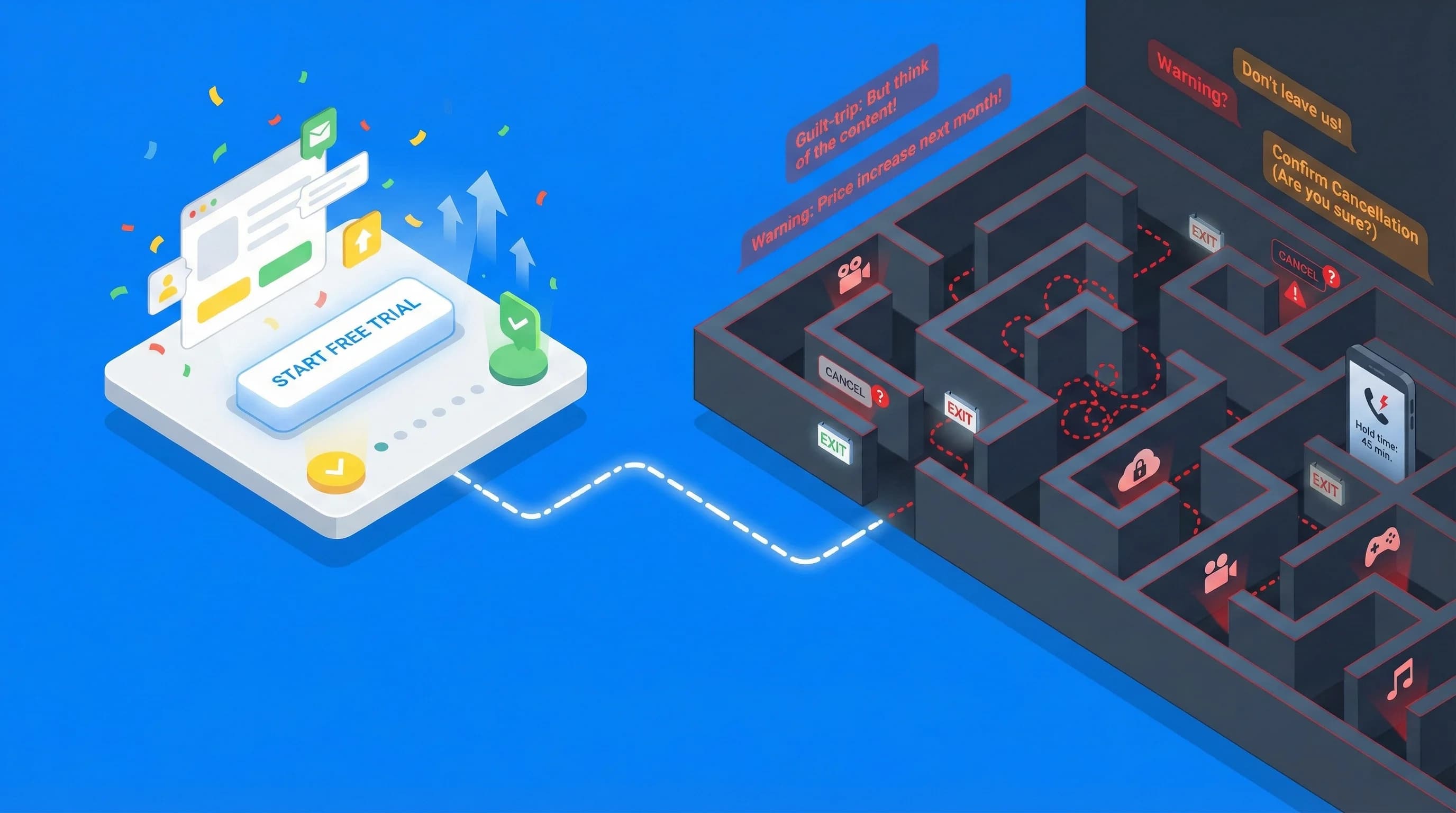
Table of Contents
You sign up for a "free trial" in 30 seconds. Three months later, you're still being charged $19.99/month for a service you haven't opened since day one. You've tried to cancel twice, but somehow, you're still paying.
This isn't an accident. It's by design.
Welcome to the subscription trap: a carefully engineered system of dark patterns, psychological manipulation, and intentional friction that turns "try it free" into "pay forever." And Americans are losing billions because of it.
The Numbers: 42% of consumers report being charged for a free trial they forgot to cancel. The average household wastes $219 annually on unwanted subscriptions. And the FTC receives over 70,000 complaints yearly about subscription traps and auto-renewal issues.
But regulators are paying attention. The FTC's Click-to-Cancel rule and related enforcement actions are targeting these practices, although legal challenges mean consumers still need to document cancellations carefully. Here's everything you need to know about subscription traps and how to escape them.
What Is a Subscription Trap?
A subscription trap is any business practice designed to make starting a subscription effortless while making cancellation difficult, confusing, or hidden. The goal isn't to provide value; it's to extract money from customers who've lost interest but can't figure out how to leave.
The trap works in three stages:
Stage 1: The Frictionless Signup
Companies optimize their onboarding to remove every possible barrier:
- One-click signup with Apple Pay or saved cards
- No password creation required (magic links)
- Pre-filled payment information
- "Start free trial" buttons everywhere
- No immediate charge to trigger spending awareness
Stage 2: The Vanishing Act
Once you're in, the company becomes invisible:
- No reminders before trial conversion
- Receipts buried in spam folders
- Charges with vague merchant names
- No usage reports or "we miss you" emails
- Silent auto-renewal with no notification
Stage 3: The Escape Maze
When you finally try to cancel, you hit the wall:
- Hidden cancellation options
- Multiple confirmation screens
- Guilt-trip messaging ("You'll lose all your progress!")
- Retention offers that require calling
- "Accidental" re-enrollment
The 7 Dark Patterns Keeping You Trapped
Dark patterns are interface designs that trick users into doing things they didn't intend. In subscriptions, they're weaponized to maximize revenue from disengaged customers.
1. The Roach Motel
The Pattern: Easy to get in, impossible to get out.
You can subscribe online in seconds, but cancellation requires calling during business hours, waiting on hold for 45 minutes, and negotiating with a retention specialist trained to refuse your request three times before "escalating" you.
Real Example: The New York Times allowed online subscriptions but required phone calls to cancel until California law forced them to offer online cancellation in 2023.
2. Obstruction (The Infinite Loop)
The Pattern: Creating unnecessary steps and confusion.
Cancel buttons buried in settings menus. Links that redirect to help articles instead of cancellation pages. Forms requiring you to explain why you're leaving before proceeding. Surveys that loop you back to the start.
Real Example: Some streaming services hide cancellation behind "Manage Plan," then "Change or Cancel," then "Continue to Cancellation," then a survey, then a retention offer, and finally a confirmation button that may or may not work.
3. Confirmshaming
The Pattern: Using guilt and shame to deter cancellation.
Instead of a simple "Cancel," you see buttons labeled: "Yes, I want to give up my premium benefits" or "I don't care about saving money" or "Abandon my fitness goals." The goal is emotional manipulation.
4. Forced Continuity
The Pattern: Silent auto-renewal with no warning.
Your annual subscription renews without any email notification. The charge appears on your statement months after you stopped using the service. By the time you notice, the "refund window" has closed.
The Data: 27% of consumers report being surprised by at least one auto-renewal charge in the past year.
5. Hidden Information
The Pattern: Burying critical terms in fine print.
The subscription terms are technically disclosed on page 7 of a 12-page terms of service, in gray text below a fold, or in a pre-checked checkbox you didn't notice. The $1 trial becomes a $99 monthly charge, but you "agreed" to it.
6. Friend Spam
The Pattern: Making you recruit friends to cancel.
Some services offer "pause" or discount options only if you refer friends, share on social media, or convince others to join. Your exit becomes their marketing opportunity.
7. The Fake Exit
The Pattern: Pretending to cancel while keeping you subscribed.
You go through the cancellation flow, see a "We're sorry to see you go" message, and assume you're done. But buried in the text: "Your subscription will remain active until the end of your billing period." Or worse, the cancellation "failed" and you need to try again.
The Psychology Behind the Trap
Why do subscription traps work so well? They exploit fundamental cognitive biases:
The Default Effect
Humans tend to stick with default options. Once subscribed, inertia takes over. Companies know that every additional step to cancel reduces cancellation rates by 10-20%.
Present Bias
We overvalue immediate rewards (the free trial) and undervalue future costs (the recurring charge). The $0 today feels more real than the $240 over the next year.
Optimism Bias
"I'll definitely remember to cancel before the trial ends." Statistically, you won't. 48% of free trial users intend to cancel but forget.
Loss Aversion
Once we have something, we fear losing it even if we don't use it. Confirmshaming exploits this by framing cancellation as "giving up" something valuable.
Sunk Cost Fallacy
"I've already paid for three months, I should keep it in case I need it later." The money is gone, but psychological ownership keeps you paying.
Why This Matters: These aren't just tricks. They're scientifically designed systems that bypass your rational decision-making. Even financially savvy people fall for them because they target automatic, not deliberate, thinking.
The FTC's Click-to-Cancel Rule: What It Means in 2026
The FTC finalized its Click-to-Cancel rule in 2024 to make recurring subscriptions easier to end. Because implementation and legal challenges can change timelines, the practical takeaway is simple: keep proof of cancellation and do not assume every company has already redesigned its cancellation flow.
The Core Requirement: Symmetry
If you can sign up online in one click, you must be able to cancel online in one click. No phone calls. No chatbots. No retention gauntlets. The cancellation process must be as easy as the signup process.
What Companies Must Do
| Requirement | What It Means |
| Simple Cancellation | Cancel must be as easy as sign-up |
| Clear Disclosures | All terms must be prominent, not buried |
| Annual Reminders | Yearly notifications of subscription status |
| Consent Documentation | Companies must prove you agreed |
| No Dark Patterns | Prohibits manipulation in cancellation flows |
| Immediate Confirmation | You must receive proof of cancellation |
The Penalties
Violations can result in civil penalties up to $50,120 per violation. For companies with millions of subscribers, this creates real accountability.
Global Momentum
The US isn't alone:
- European Union: The Digital Fairness Act requires equal ease for cancellation
- California: Already mandates online cancellation if online signup exists
- United Kingdom: The Digital Markets, Competition and Consumers Act targets subscription traps
- Australia: ACCC actively prosecutes misleading subscription practices
Real Companies, Real Traps
These aren't hypothetical scenarios. Major companies have been sued, fined, or forced to change practices:
Amazon Prime: The Six-Click Cancellation
The FTC sued Amazon in 2023, alleging Prime's cancellation process was deliberately complicated. Internal documents reportedly called the process "Iliad," a reference to the epic Greek journey, to describe the six-page, multi-click flow designed to deter cancellations. Amazon has since simplified the process.
Adobe: The Early Termination Fee Surprise
Adobe's annual plans advertise a monthly rate, but canceling early triggers a fee for the remaining months, sometimes hundreds of dollars. Many users don't realize they signed a year-long contract until they try to leave. The FTC has cited this as a problematic practice.
Match.com: The Fake Love Interest
The FTC sued Match for allegedly sending promotional emails from fake profiles to entice non-paying users to subscribe, only for them to discover that "messaging" required a paid subscription. While not a pure cancellation issue, it demonstrates the deceptive mindset.
HelloFresh and Meal Kits: The Phone-Only Cancellation
Multiple meal kit companies have faced scrutiny for requiring phone calls to cancel while allowing online signups. Some states now require these companies to offer online cancellation options.
Sources and Further Reading
- FTC announcement of the final Click-to-Cancel rule.
- FTC action against Amazon Prime enrollment and cancellation practices.
- FTC action against Adobe over fees and cancellation practices.
- SubBuddy's cancellation guide for practical next steps after spotting a trap.
How to Escape a Subscription Trap
If you're stuck in a subscription trap right now, here's your escape plan:
Method 1: The Direct Route (If Available)
Step 1: Log into your account
Step 2: Navigate to Settings → Billing → Subscriptions
Step 3: Look for "Cancel," "End Subscription," or "Close Account"
Step 4: Document everything: screenshots of confirmation, confirmation emails, and cancellation dates
Step 5: Check your statement next month to verify
Method 2: The Nuclear Option (When They Make It Hard)
If the company requires phone calls or creates obstacles:
- Call your bank or credit card company and dispute the charges as unauthorized
- Request a new card if the subscription continues charging (nuclear, but effective)
- Use virtual cards for future subscriptions; you can cancel the virtual number instantly
Method 3: The Legal Route
If you've been charged improperly:
- File a complaint with the FTC at reportfraud.ftc.gov
- Submit a complaint to your state attorney general
- Use consumer protection laws; many states have specific subscription regulations
- For significant amounts, consider small claims court
Method 4: The Guerrilla Tactics
When customer service refuses to help:
- Post on the company's public social media; bad PR gets attention
- Contact the CEO or executives via LinkedIn or email
- Use services like DoNotPay or Rocket Money's cancellation concierge
- Report to the Better Business Bureau
How to Avoid Subscription Traps
The best defense is never entering the trap. Here's your prevention protocol:
Before Signing Up
- Read the cancellation policy first, before the trial rather than after
- Search "[company] cancel" and see what others say about the process
- Use a virtual credit card; services like Privacy.com let you create single-use cards
- Set multiple reminders: 2 days before the trial ends, 1 day before, and the day of
- Take screenshots of the cancellation process immediately after signing up
During the Trial
- Try to cancel immediately to see how hard it actually is while you still have leverage
- Block calendar time specifically for cancellation review
- Add it to SubBuddy immediately and track the trial end date with alerts
After Converting to Paid
- Schedule quarterly audits of all subscriptions
- Set calendar reminders before annual renewals
- Monitor statements monthly for unexpected charges
- Use a dedicated email for all subscriptions to centralize communications
Tools to Fight Back
Several tools can help you avoid or escape subscription traps:
SubBuddy (Our Solution)
Built specifically to prevent subscription waste:
- Trial tracking: Set end dates with automatic alerts 3 days, 1 day, and day-of
- Visual calendar: See all renewals at a glance
- Spending analytics: Identify which subscriptions you're not using
- Category insights: Spot overlapping services
- Renewal reminders: Never be surprised by an auto-renewal again
Virtual Credit Cards
- Privacy.com: Create merchant-locked or single-use cards
- Revolut: Virtual cards with spending limits
- Apple Card: Unique virtual numbers for each merchant
Cancellation Services
- Rocket Money: Premium users can request cancellation assistance
- DoNotPay: AI-powered cancellation for difficult services
- Truebill (now Rocket Money): Negotiates and cancels on your behalf
The Future of Subscription Traps
The Click-to-Cancel rule is a start, but the battle isn't over. Here's what to watch:
Companies Will Adapt
Expect new tactics: shorter trial periods, higher upfront commitments, "pause" options that keep you in the system, or requiring longer signup flows to justify complex cancellations.
Regulation Will Expand
The EU, UK, Australia, and US states are all tightening rules. By 2027, subscription traps may face global prohibition.
Consumer Awareness Is Growing
As awareness spreads, companies using dark patterns face reputational damage. The "subscription trap" label is becoming toxic.
The Rise of "Honest Subscriptions"
Forward-thinking companies are differentiating themselves with easy cancellation as a selling point. "Cancel anytime, no questions asked" is becoming a competitive advantage.
Your Action Plan
Don't let another month go by funding companies that trap you. Here's what to do today:
Immediate (Next 30 Minutes):
- Review your bank statement for the last 3 months
- Identify any subscriptions you don't actively use
- Attempt to cancel at least one using the methods above
- Document the cancellation process with screenshots
This Week:
- Add all active subscriptions to SubBuddy with their renewal dates
- Set calendar reminders for any annual renewals
- For any trials, set cancellation reminders 2 days before they convert
Ongoing:
- Monthly: Review subscription charges on your statement
- Quarterly: Full subscription audit. What's worth keeping?
- Annually: Review and negotiate rates on services you're keeping
Remember: The subscription economy relies on your inertia. Every subscription you consciously evaluate and either keep with intention or cancel with conviction is a small act of taking back control. The companies know the psychology. Now you do too.
Related reading: Learn what current data says about average subscription spending, discover the common hidden subscription categories, or read our guide on the hidden cost of free trials.
Alex Coca
Alex Coca is the independent developer behind SubBuddy. He researches subscription billing, cancellation patterns, and recurring-spend workflows by building the product and reviewing real subscription audits from users and his own accounts.
Don't Let Subscriptions Trap You
Join thousands using SubBuddy to track subscriptions, get renewal alerts, and never fall for a subscription trap again.
Start Tracking FreeRelated Articles
How Much Does the Average American Spend on Subscriptions? What the Best Data Shows
There is no single perfect subscription average. Current public studies measure different baskets, from $219/month across subscription services to $69/month for four paid streaming services.
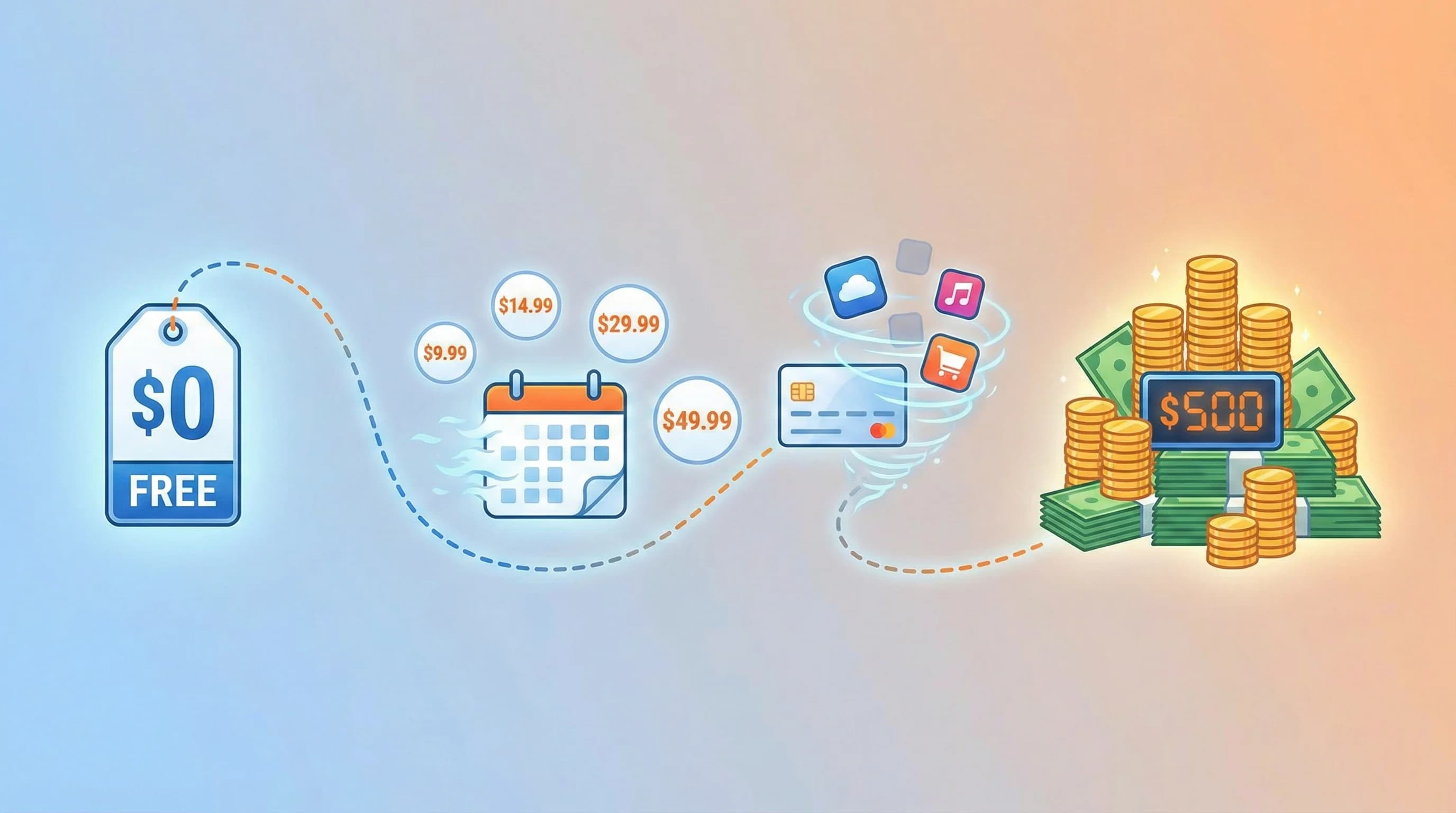
The Hidden Cost of Free Trials: How $0 Becomes $500/Year
That 'free' trial you forgot about? It's not free anymore. Discover how forgotten free trials are costing Americans an average of $500 per year and learn the exact steps to stop the bleeding.
How to Audit Your Bank Statement and Find Hidden Subscriptions in 30 Minutes
Stop letting forgotten subscriptions drain your bank account. This step-by-step guide shows you exactly how to audit your statements, identify hidden charges, and reclaim your money, all in half an hour.