The 'Click-to-Cancel' Plot Twist: Why the FTC's Dream Rule Is Stalled in 2026 (And How to Protect Yourself Anyway)
Table of Contents
You probably heard the headlines in late 2024: "FTC passes landmark Click-to-Cancel rule." It promised to make canceling any online subscription as simple as signing up. No 45-minute phone holds, no begging chatbots, and no hidden cancellation mazes. If you could join in one click, you could leave in one click.
Yet, here you are in May 2026, trying to cancel a fitness app or a software license, and you're still being forced to call customer service or click through seven pages of "Are you sure?" confirmation guilt-trips.
What happened? Why didn't the federal government fix this?
Welcome to the biggest legal plot twist in the subscription economy. The FTC's dream rule is currently dead in the water, struck down by a federal court. But while the regulators are tied up in legal battles, consumers aren't completely defenseless. Here is the untold story of the 2026 Click-to-Cancel court battle, the sneaky ways companies are exploiting this delay, and the exact playbook you can use to force easy cancellations anyway.
Fact Check: Despite what many personal finance blogs are still claiming, there is currently no active federal Click-to-Cancel rule in effect. The landmark regulation was completely vacated by the federal courts, forcing the FTC to restart a multi-year rulemaking process in March 2026.
Methodology & Source Note:
This analysis is based on Federal Trade Commission (FTC) regulatory filings, the U.S. Court of Appeals for the Eighth Circuit docket records, California legislative updates (AB 2863), and direct observations of subscription cancellation flows as of May 2026.
The 2025 Court Stunner: How Click-to-Cancel Was Vacated
To understand why subscriptions are still so hard to cancel today, we have to go back to July 8, 2025.
The FTC's final Click-to-Cancel rule (officially an update to the 1973 Negative Option Rule) was scheduled to go into full effect. It mandated "cancellation symmetry"—a strict rule requiring companies to make exit paths just as simple as sign-up flows. But a coalition of business groups, led by broadband associations and marketing groups, filed a lawsuit challenging the rule in the U.S. Court of Appeals for the Eighth Circuit.
In a major blow to consumer protection advocates, the court ruled in favor of the business lobby and vacated the entire rule.
The court's decision turned on a highly technical but consequential procedural problem. The challengers raised broader arguments too, but the court did not need to decide them after finding the FTC's process was legally deficient:
- Procedural Misstep: The court held that the FTC failed to issue a required preliminary regulatory analysis after an administrative law judge found the rule would likely have more than a $100 million annual economic effect.
- Unresolved Authority Arguments: The petitioners also argued that the FTC exceeded its statutory authority by applying a broad rule across industries, but the Eighth Circuit explicitly did not reach those substantive challenges.
- Administrative-Law Reality: For consumers, the practical result is the same: the rule was vacated before businesses had to comply, and any replacement rule will need a cleaner administrative record.
Because the court vacated the rule rather than merely pausing it, the federal Click-to-Cancel mandate was erased from the books before it could even begin to protect consumers.
Where the FTC and the Rule Stand in 2026
The FTC hasn't given up, but the road back is long and frustrating. On March 11, 2026, the Commission announced that it was seeking public comment through an Advance Notice of Proposed Rulemaking (ANPRM) on negative option marketing practices.
By reopening the process with a more complete administrative record, the FTC can try to address the procedural problem that sank the 2024 rule. However, standard federal rulemaking is slow. The process may require:
- An initial public comment period on the ANPRM.
- The drafting of a formal Proposed Rule.
- Another round of public hearings and comments.
- A final rule publication, followed by a compliance period before businesses must follow the new requirements.
Realistically, even if the FTC faces no further legal setbacks, a new federal Click-to-Cancel rule could easily stretch into 2027 or later. In the meantime, there is no active federal cancellation-symmetry rule, although ROSCA, Section 5 of the FTC Act, and state automatic-renewal laws can still apply to deceptive or unfair cancellation practices.
The State Laws Saving the Day (The Hidden Shield)
While the federal government is tied up in administrative knots, individual states have stepped up to fill the void. In fact, if you live in the United States, your primary defense against subscription traps isn't the FTC—it's state-level Automatic Renewal Laws (ARLs).
A patchwork of strict state laws remains fully active and enforceable. Most notably, California's AB 2863 applies to covered contracts entered into, amended, or extended on or after July 1, 2025, and has become one of the strictest state standards. California's law includes requirements such as:
- One-Click Cancellation: Businesses must provide a direct, online cancellation link (or a pre-written email template) if they allow online sign-up.
- No Obstruction: Online cancellation flows cannot bury the exit behind retention offers or extra steps that obstruct or delay termination.
- Reminders and Change Notices: Companies must send annual reminders for covered renewals and provide clear notice before material changes or fee changes.
Because major tech, streaming, and retail companies cannot easily maintain two entirely different website architectures for California residents and the rest of the country, many have quietly rolled out online cancellation buttons to all users—but they often bury them deep in settings for non-California users.
| Jurisdiction | Online Cancel Required? | Phone/Chat Opt-Out Safe? | Annual Reminders Mandated? |
|---|---|---|---|
| US Federal (FTC) | No (Vacated by Court) | ROSCA/FTC Act Still Apply | No |
| California (AB 2863) | Yes (Strict Symmetry) | Yes (No Gatekeeping Allowed) | Yes (Highly Detailed) |
| New York (ARL) | Yes (If Signed Up Online) | No | Yes |
| European Union | Mixed; DFA Not Enacted | Country/Sector Specific | Proposed/Varies |
How to Force "Click-to-Cancel" Today (The Consumer Playbook)
Since companies aren't legally forced by federal law to make cancellation easy, they will continue to make you jump through hoops. If you run into a subscription trap, use these four advanced consumer hacks to force an easy exit.
Hack 1: Leverage State-Based Digital Cancellation Compliance
Because companies must comply with California's strict AB 2863 and New York's automatic renewal laws, some large subscription platforms already support cleaner online cancellation flows for covered accounts. Those flows may be easier to find when your account information accurately reflects a covered state.
The Playbook: If you are a resident of California or New York (or have a legitimate billing or shipping relationship tied to these states) and find yourself stuck in a phone-only cancellation loop:
- Log into your profile settings on the service's website.
- Ensure your state and billing information are fully updated and accurate. For covered accounts, accurate state details may expose the correct online cancellation path.
- Even if you aren't located in California, you can politely ask customer support to provide the same online cancellation path they use for covered users or to process your cancellation immediately and confirm it in writing.
Hack 2: Leverage ROSCA & ROSCA-adjacent Legal Magic Words
While the specific Click-to-Cancel rule is stalled, the FTC still aggressively enforces the Restore Online Shoppers' Confidence Act (ROSCA). ROSCA makes it illegal for companies to charge you automatically unless they clearly disclose all material terms and provide a simple mechanism to stop recurring charges.
The Playbook: If you are emailing customer support or arguing with a live chatbot that refuses to let you cancel without a call, copy and paste this exact text:
"Under Section 5 of the FTC Act and the Restore Online Shoppers' Confidence Act (ROSCA), online negative-option sellers must provide a simple mechanism to stop recurring charges. If my account is covered by a state automatic-renewal law such as California's AB 2863 or New York's ARL, please provide the required online cancellation path. Otherwise, please process my cancellation immediately and confirm in writing. I have screenshotted this request for my records and will file an FTC and State Attorney General complaint if charges continue."This language gives support a clear written cancellation request, names the federal standard that still exists after the vacated rule, and creates a useful paper trail if charges continue.
Hack 3: The Payment-Processor Kill Switch (Virtual Cards)
Never give your real credit or debit card to a subscription service. If you do, they hold the keys to your vault.
The Playbook: Use virtual card services (like Privacy.com, or the built-in virtual card features in Revolut and Capital One) to sign up for all subscriptions. When you want to cancel, don't even bother navigating the company's escape maze. Simply go into your virtual card app and click "Close Card" or set a hard spending limit of $0. The next time the company tries to charge you, the payment will bounce, and your subscription will auto-terminate without you ever having to speak to a human.
Hack 4: Leverage App Store Billing
Whenever possible, subscribe to services through the Apple App Store or Google Play Store. Yes, developers hate the 15-30% "Apple Tax," but for consumers, it centralizes billing. Apple and Google provide unified cancellation screens in your phone or account settings that can bypass an app's individual retention flow entirely.
The 2026 Subscription Prevention Protocol
The best defense against a subscription trap is ensuring you have complete visibility over the relationship from day one. Do not let companies rely on your forgetfulness. Use this three-step protocol for every single recurring signup:
1. Capture the Evidence at Signup
When signing up for any "free trial" or promotional offer, take a 2-second screenshot of the checkout screen showing the price, the renewal date, and the cancel terms. Keep these in a dedicated email folder or cloud drive. If you ever need to dispute a charge with your bank, this screenshot is your bulletproof evidence.
2. Test the Exit Before You Get Comfortable
The minute you sign up for a trial, navigate to the billing settings immediately. See if there is a cancel button. If you see a message saying "To cancel, please call 1-800...", cancel the trial immediately on day one. Most major platforms (like Apple, Google, and premium SaaS) will let you cancel the trial immediately while still letting you use the service for the remainder of the trial period.
3. Set a Double-Buffer Alert
Never rely on a single calendar event to cancel a trial. Set a double-buffer alert: one reminder 3 days before the trial ends (giving you time to fight a phone maze if necessary), and one reminder the day before the charge converts.
How SubBuddy Shields You from Courtroom Delays
The FTC's legal battle in the Eighth Circuit shows that regulators cannot protect your wallet in real-time. Laws take years to write, get struck down in courts, and take years to rebuild.
That is why we built SubBuddy. We don't wait for the FTC to enforce symmetry—we give you the direct control to enforce it yourself.
- Privacy-First Local Alerts: SubBuddy schedules local, on-device notifications at 09:00 AM, completely customizable from 1 to 30 days prior to your renewal date so you are never caught off guard.
- Card and Tag Tracker: Keep track of exactly which credit, debit, or virtual card is tied to each subscription using customizable tags and last-4 digit logging, so you know exactly which account to freeze if a merchant makes canceling difficult.
- Custom Cancellation URL Vault: Store and organize your own direct cancellation links for each subscription, letting you launch the exact exit screen in a single tap right from your dashboard.
Take Action: Secure Your Subscriptions Today
Do not let corporate lawyers and federal court battles dictate your bank account's safety. Take 15 minutes today to audit your active bills:
- Open your banking app and write down every recurring charge from the last 60 days.
- Compare it against your active app store subscriptions.
- Identify at least one service you haven't used in the past month.
- Use our compliance triggers or our ROSCA email template to kill that charge today.
- Log the remaining "must-keeps" into SubBuddy so you are locked, loaded, and protected against the next round of price hikes.
The Bottom Line: Click-to-Cancel is stalled in Washington, but it doesn't have to be stalled in your household. Take back the keys to your wallet today.
Alex Coca
Founder & CEO of SubBuddy. After falling victim to multiple subscription traps himself, Alex built SubBuddy to help consumers fight back against dark patterns and take control of their recurring expenses.
Don't Wait for the FTC
Join thousands using SubBuddy to manage renewals, get double-buffer alerts, and bypass dark patterns today.
Protect Your WalletRelated Articles
The Subscription Trap: How Dark Patterns Keep You Paying (And the Law Finally Fighting Back)
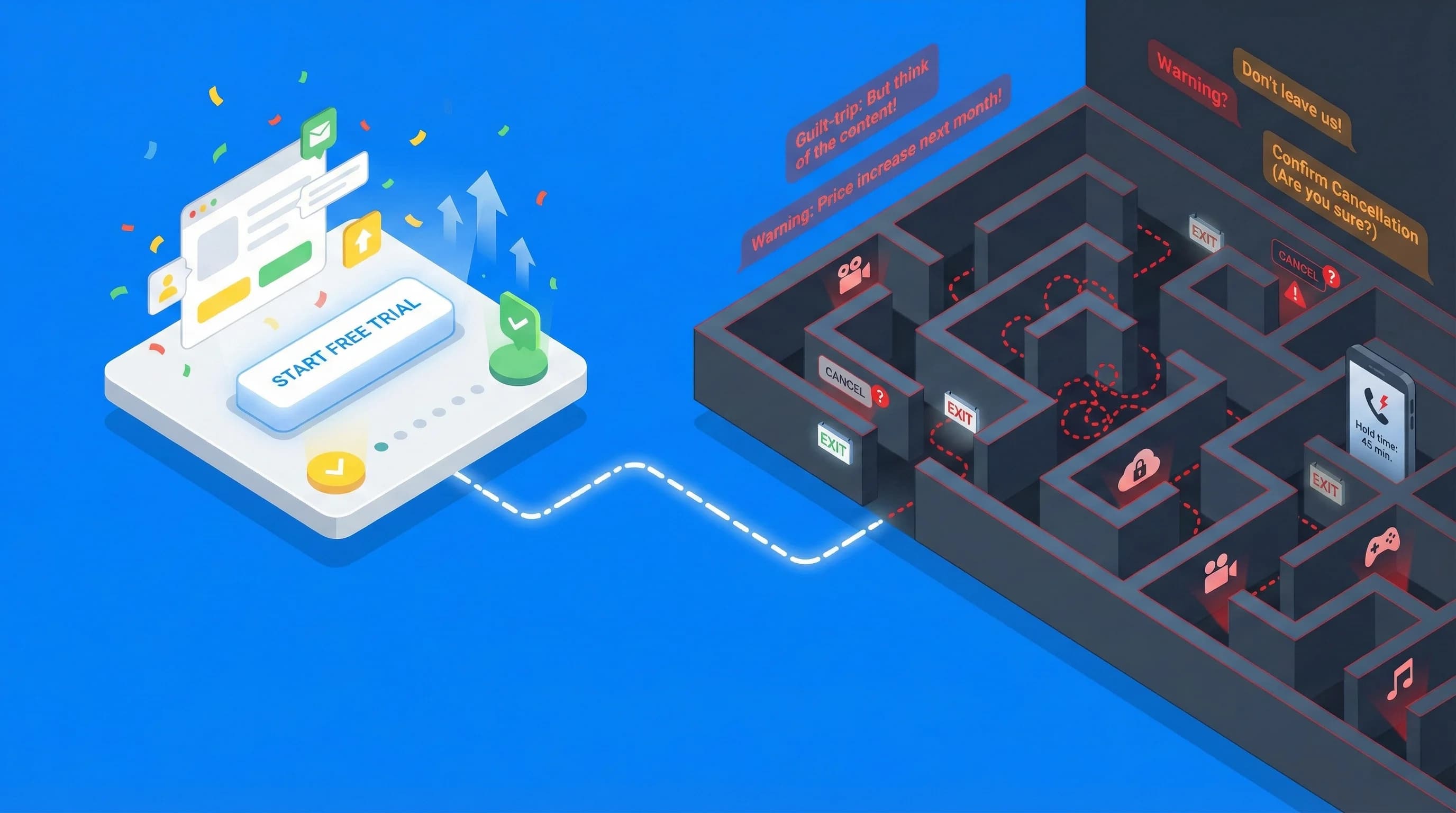
Companies intentionally make subscriptions easy to start and nearly impossible to cancel. Learn the psychology behind subscription traps and recognize dark patterns.
The Hidden Cost of Free Trials: How $0 Becomes $500/Year
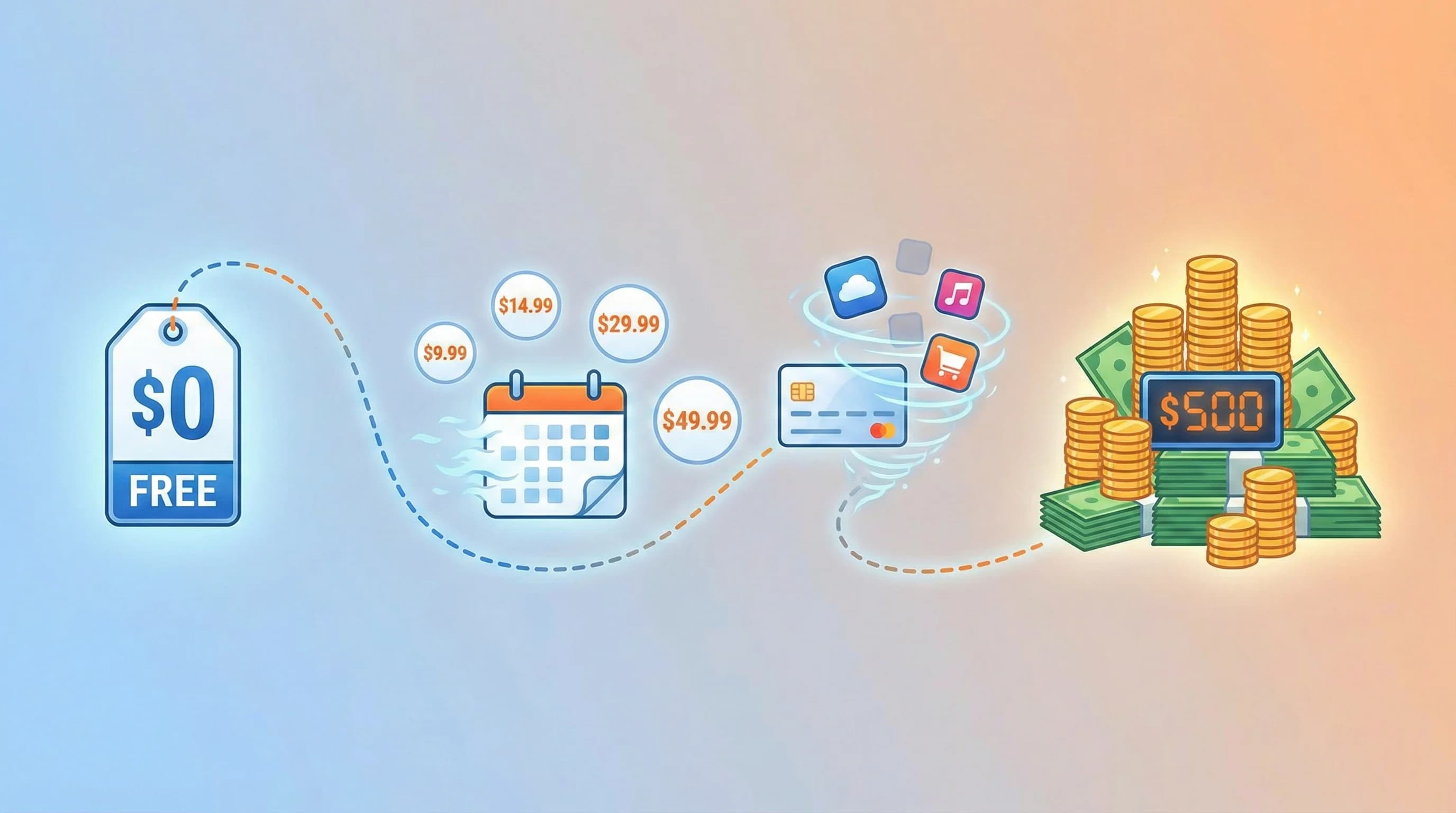
That 'free' trial you forgot about? It's not free anymore. Discover how forgotten free trials are costing Americans an average of $500 per year.
How to Audit Your Bank Statement and Find Hidden Subscriptions in 30 Minutes
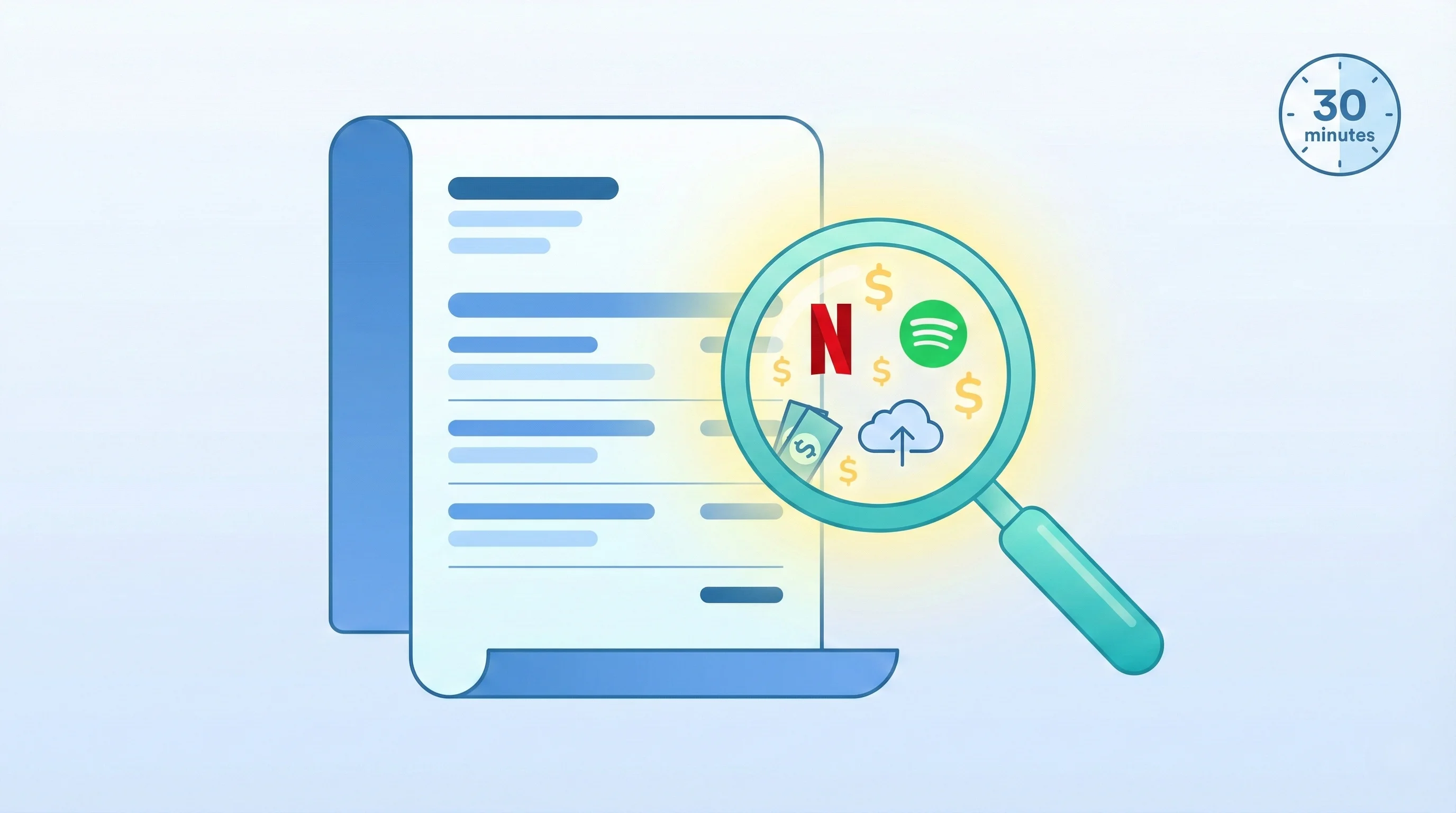
Stop letting forgotten subscriptions drain your bank account. This step-by-step guide shows you exactly how to audit your statements, identify hidden charges, and reclaim your money.