The Annual Subscription Math Trap: Why 'Saving 20%' Costs Most People $300+ in 2026
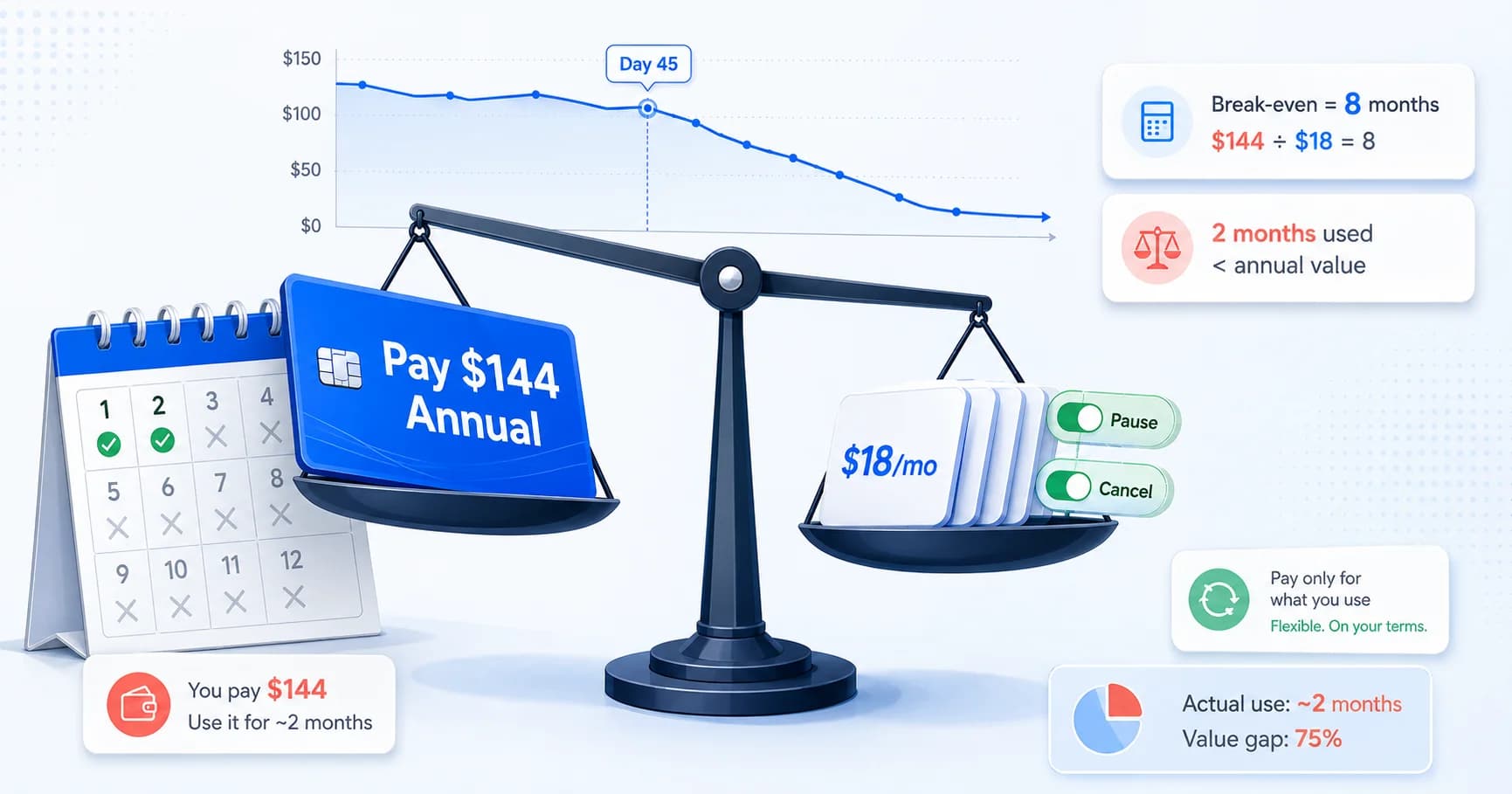
Table of Contents
Every pricing page on the internet offers the same seductive proposition: "Pay monthly for $18/mo, or pay annually and save 20% ($144/year)." Your brain immediately frames this as a free $72 discount. You congratulate yourself on being financially savvy, enter your card details, and pay the lump sum upfront.
Fast forward three months. You haven't opened the language learning app since March, the workout app is gathering digital dust, and the niche AI design tool was replaced by a free alternative. That $144 upfront payment wasn't a $72 saving: it was a $90 net loss compared to paying monthly for the two months you actually used.
This is the Annual Subscription Math Trap, one of the most profitable monetization levers in modern software and subscription commerce. Here is why it works, the mathematical formula to protect your wallet, and how to decide whether to commit upfront.
The Illusion of the 20% Discount
When software companies offer an annual discount, they are not giving away free money. They are buying insurance against your churn. The average consumer evaluates an annual plan using optimism bias: assuming their future self will be disciplined, motivated, and consistent 365 days from now.
Subscription companies know the reality: consumer engagement drops precipitously after the initial excitement wears off. By securing 100% of the annual contract value on day one, the merchant eliminates revenue risk entirely.
The 60-Day Usage Cliff
Consumer behavior studies reveal a consistent pattern across discretionary subscription categories (fitness, self-improvement, niche streaming, and secondary productivity apps):
- Days 1 to 14: High engagement (onboarding honeymoon).
- Days 15 to 45: Usage drops by 45% to 60%.
- Days 46 to 90: Over 62% of users open the app fewer than twice per month.
- Days 91 to 365: Complete dormancy (the subscription becomes "shelfware").
When you pay monthly, the third month's invoice serves as a natural friction point that prompts you to cancel. When you pay annually, there is no recurring bill to trigger that evaluation, and your money is already gone.
The Break-Even Usage Formula
Before ever selecting the annual toggle on a checkout page, calculate your Break-Even Usage Threshold:
Break-Even Months = Annual Upfront Price / Monthly Price
Consider three real examples from popular services:
- Canva Pro: $18/month vs $144/year. Break-even = 8.0 months ($144 / $18). If you use it for 7 months or less and cancel, monthly billing is cheaper.
- Duolingo Super: $13.99/month vs $95.99/year. Break-even = 6.8 months. If you abandon your language streak after 4 months, paying monthly saves you over $40.
- Strava: $11.99/month vs $79.99/year. Break-even = 6.7 months. If you only run or cycle outdoors from May through September (5 months), subscribing monthly saves you ~$20 every year.
When Annual Is Actually Smart
Annual billing is not always bad. It is mathematically advantageous when applied to Core Infrastructure Subscriptions that meet all three of these criteria:
- High migration friction: Services that hold your core data, such as password vaults (1Password), primary cloud storage (Google One, iCloud+), or primary work suites (Microsoft 365).
- Proven historical usage: Tools you have already used consistently for at least 90 consecutive days.
- Zero seasonal variation: Services you need in equal measure in January and July.
When Annual Is Guaranteed Waste
Avoid annual commitments in these high-churn categories:
- Aspirational fitness & wellness apps: Workout programs, meditation apps, and diet trackers have the highest dormancy rates in the software industry.
- Fast-moving AI tools: New AI models and features launch monthly. Paying $200 upfront for an annual AI wrapper often leaves you locked into obsolete tech within 4 months.
- Niche streaming services: Platforms with one specific show or franchise. Subscribe for 1 month, binge the catalog, and cancel.
- Language learning apps: High initial enthusiasm followed by rapid drop-off.
The 30-Day Evaluation Rule
To eliminate annual subscription waste permanently, implement the 30-Day Test Rule:
- Always choose the monthly plan when first trying any new service, even if the annual discount looks tempting.
- Set a reminder in SubBuddy for Day 25.
- On Day 25, review your actual usage over the past month. If you used the tool at least 4 days per week and plan to use it for the next 9 months, upgrade to annual to capture the discount.
- If your usage was sporadic, cancel immediately. You only risked one month of fees instead of a full year.
How to Audit Your Annual Commitments
SubBuddy's Annual Equivalent Cost feature automatically calculates the annualized commitment of every subscription in your dashboard. By comparing your monthly totals with your annual renewals, you can identify lump sums before they hit your bank account and rotate off dormant services before they auto-renew.
Alex Coca
Alex Coca is the independent developer behind SubBuddy. He researches subscription billing, cancellation patterns, and recurring-spend workflows by building the product and reviewing real subscription audits from users and his own accounts.
Calculate Your True Annual Spend
Use SubBuddy to compare monthly vs annual commitments and spot zombie subscriptions before they renew.
Audit Your SubscriptionsRelated Articles
How Much Does the Average American Spend on Subscriptions? What the Best Data Shows
There is no single perfect subscription average. Current public studies measure different baskets, from $219/month across subscription services to $69/month for four paid streaming services.
The Hidden Cost of Free Trials: How $0 Becomes $500/Year
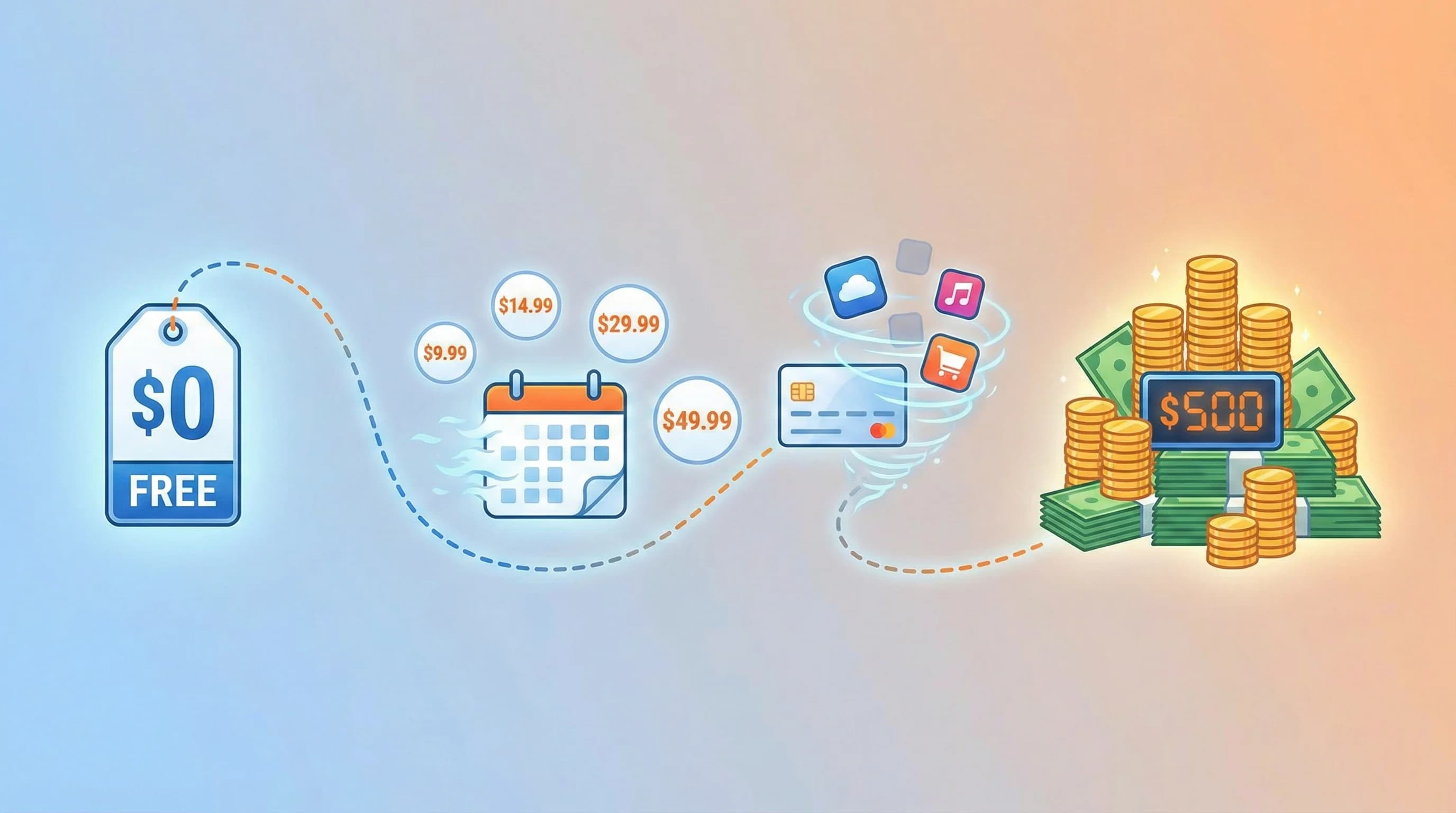
That 'free' trial you forgot about? It's not free anymore. Discover how forgotten free trials are costing Americans an average of $500 per year and learn the exact steps to stop the bleeding.

The Psychology of Subscription Fatigue: Why We Don't Cancel
Ever wonder why you keep paying for that streaming service you haven't watched in months? It's not just laziness. It's psychology. We dive into the behavioral economics keeping you subscribed.