Click-to-Cancel Died Federally. Your State May Still Have Your Back: The 2026 Auto-Renewal Map
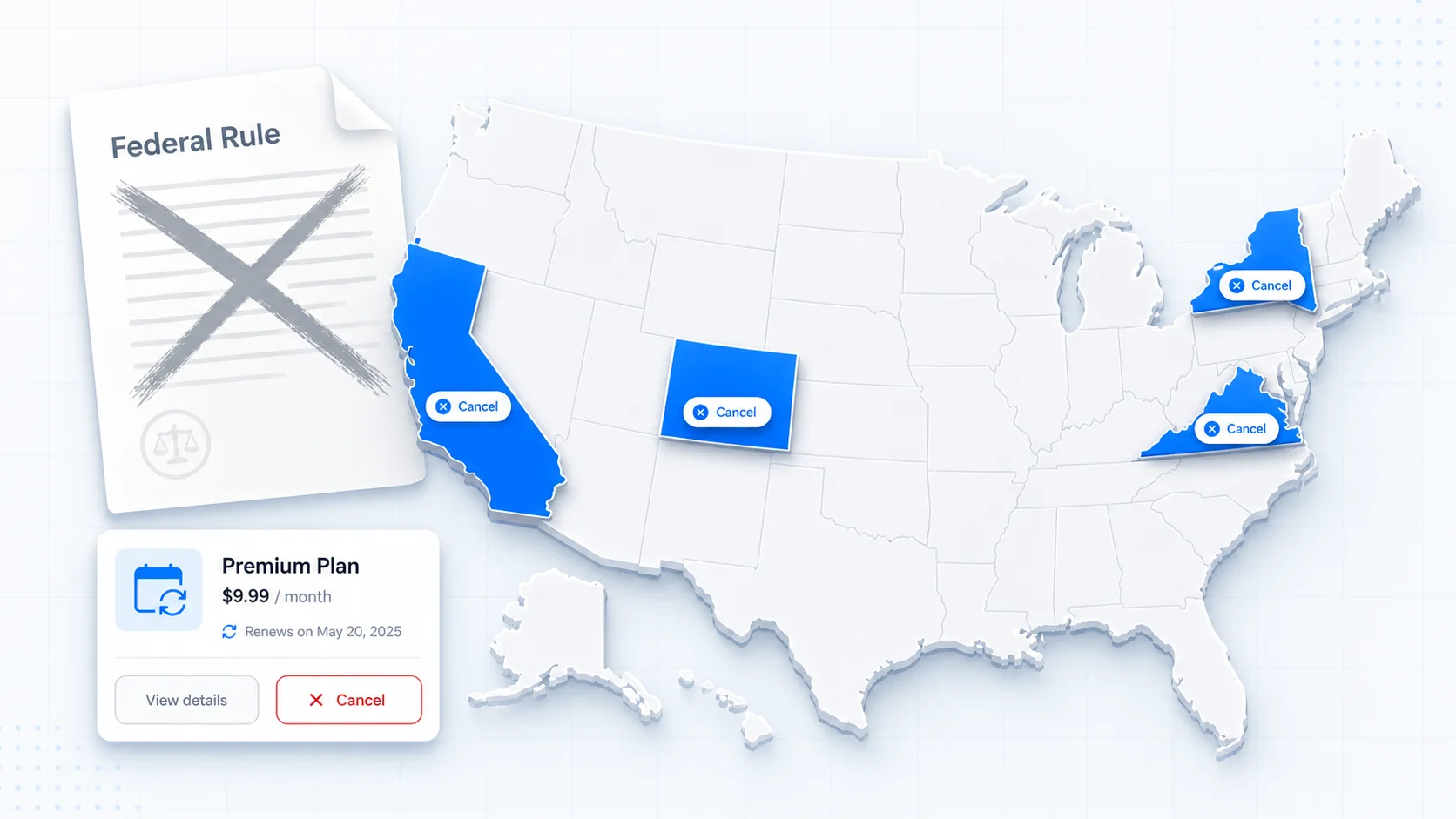
Table of Contents
For most of 2024 the story was simple: the FTC had passed a national Click-to-Cancel rule, and canceling subscriptions was about to get easier for everyone in the country. That story fell apart. A federal appeals court threw the rule out, and as of June 2026 there is no broad federal click-to-cancel requirement in force. If you stopped following the news there, you would assume you are back to the bad old days of phone-tree cancellations and hidden "are you sure" mazes.
You are not, and that is the part almost nobody is telling consumers. While the federal rule was dying, individual states quietly built their own. Depending on where you live, you may already have the right to cancel any subscription in one click, to get a prorated refund when a price goes up without your consent, or to demand a cancel button inside an app. This post maps those state laws, shows you how to tell which one covers you, and turns them into a practical way to get out of a subscription that is fighting you.
Last reviewed: June 16, 2026. This summarizes federal and state auto-renewal developments as of this date and is general information, not legal advice. Laws change and the details below are simplified. Confirm the current text of any rule, and your own state's consumer protection guidance, before relying on it.
Methodology & Source Note:
The federal timeline is drawn from the FTC's own Negative Option Rule page and dated reporting on the Eighth Circuit decision. The state summaries are based on the statutes and law-firm analyses linked in the Sources section, including the California bill text and client alerts from Perkins Coie and Greenberg Traurig on New York, Colorado, and Virginia. Effective dates and core requirements are quoted from those sources. I am the founder of a subscription-tracking product and a consumer advocate, not a lawyer, so treat this as a practical orientation map rather than a legal opinion.
The Federal Situation: What Actually Happened
Here is the short version, in order.
- October 2024: The FTC finalized its amended Negative Option Rule, the one everyone called "Click-to-Cancel." It would have required canceling to be as easy as signing up across most subscriptions nationwide.
- July 2025: The U.S. Court of Appeals for the Eighth Circuit vacated the rule, finding the FTC's rulemaking process was procedurally insufficient. The national requirement never took full effect.
- February 2026: The FTC formally reverted to the older, much narrower Negative Option Rule that existed before the 2024 amendments. That older rule applies mainly to prenotification plans and does not reach most modern free trials, auto-renewals, and continuity plans.
- March 2026: The FTC opened an Advance Notice of Proposed Rulemaking, asking for public input before drafting a new version, with comments due April 13, 2026.
So the federal picture in mid-2026 is: no broad click-to-cancel rule in force, an old narrow rule back in place, and a fresh rulemaking process underway that could eventually produce a new national rule. That last point matters. "Stalled" does not mean "dead forever." But you cannot plan your cancellations around a rule that does not exist yet. What you can use is your state's law.
The State Auto-Renewal Map: 2026
Four states stand out because their laws are detailed, recently updated, and either in force now or arriving in 2026. This is the table to bookmark.
| State | In force | What it gives you |
|---|---|---|
| California (AB 2863) | July 1, 2025 | Cancel through the same medium you signed up in, affirmative consent to auto-renew, clear renewal reminders for annual plans |
| New York | Nov 5, 2025 | Consent to price increases, or a prorated refund within 14 days if you did not consent; renewal reminders 15 to 45 days before the deadline on plans of a year or longer; advance notice of material changes |
| Colorado | Feb 16, 2026 | One-step online cancellation link if you signed up online; covers business subscriptions too; retention offers allowed only if a direct cancel link is shown alongside |
| Virginia | July 1, 2026 | Cancel through every channel you could sign up in (except in-person), at least as easily as you joined; free phone cancellation during business hours |
Beyond these four, a growing list of states have some form of "cancel as easily as you signed up" or strengthened auto-renewal disclosure on the books, including Utah, Idaho, Massachusetts, Georgia, Minnesota, Illinois, and Arkansas. The details vary, but the direction is consistent: states are filling the gap the federal rule left. New York City even proposed its own municipal click-to-cancel rule in 2026, the first city-level effort of its kind.
Which Law Actually Covers You
This is the question people get wrong, so here is the practical version.
Your protection generally follows where you live, not where the company is. These laws are written to protect consumers in that state. A California resident gets California's protections even when subscribing to a company headquartered elsewhere. So the first thing to check is your own state's auto-renewal law, not the service's home state.
But many national companies apply the strictest standard to everyone. Geofencing a separate cancellation flow for each state is more work than simply building one easy-cancel button and shipping it nationwide. That means residents of states without a strong law often benefit anyway, because the company built its flow to satisfy California or New York. You may have an easy-cancel option even if your state never required one. It is worth looking before you assume you are stuck.
And you always have non-state backstops. Regardless of your state, you can dispute an unauthorized or post-cancellation charge with your card issuer, and you can stop a recurring charge through your bank. Those are not the same as a legal right to easy cancellation, but they are real tools when a company stonewalls. We walk through them in the complete guide to canceling on every platform.
How To Actually Use These Rights
A law only helps if you invoke it. Here is the sequence that works whether or not your state is on the map above.
- Find the cancellation path in the same channel you joined. If you signed up online, look for an online cancel option first. California and Virginia law point you here, and most national services now offer it because some state required it of them.
- If a "save offer" blocks you, look for the direct cancel link. Colorado's law specifically requires a continuously visible link to proceed to cancellation alongside any retention pitch. Many companies now show one nationwide. Decline the offer and click straight through.
- If a price went up, check your refund window. In New York, if your price increased without your affirmative consent, you can cancel and request a prorated refund within 14 days of the first higher charge. Even outside New York, raising this can shake loose a refund.
- Name the law in writing. If you are stonewalled, a short message that references your state's auto-renewal law and your state attorney general's consumer protection office changes the tone fast. You do not need to be a lawyer to write "Under [my state]'s auto-renewal law, please process my cancellation and confirm in writing."
- Document everything and escalate if needed. Screenshot the cancellation, save the confirmation, and note the date. If the charge keeps coming, dispute it with your card issuer and file a complaint with your state attorney general or the FTC. A paper trail is what makes a dispute win.
What Not To Do
A few traps that cost people money even when the law is on their side.
- Do not assume "I canceled" means the billing stopped. Cancellation is not done until you have a written confirmation and the renewal date has passed without a charge. Plenty of "canceled" subscriptions bill one more time because the cancel never actually completed.
- Do not accept a retention discount you will forget. A half-price "stay" offer that you ignore for six months is not a win, it is a smaller version of the same problem. Take it only if you genuinely want the service at that price.
- Do not rely on a future federal rule. The FTC's new rulemaking might produce a national standard later. It does not protect you today. Use the law that exists now.
- Do not let a "free" trial auto-convert unwatched. The narrow federal rule back in place does not cover most trial conversions, so this is squarely on you and your tracker.
The Move That Makes Any Law Work: Track the Renewal
Here is the uncomfortable truth under all of this. Easy-cancel laws help most when you cancel on purpose, before a renewal, on your own schedule. They help least when you discover a charge months later and have to fight backward. The law lowers the friction of canceling. It does nothing about remembering to cancel. That part is still yours.
So the highest-leverage thing you can do is not legal at all, it is logistical: know when every subscription renews, and decide before that date whether to keep it. When you track renewals, these state laws become a clean exit you choose, instead of a tool you reach for in frustration after the money is already gone. Record each subscription's renewal date and price, set a reminder a few days ahead, and use that window to make the keep-or-cancel call while canceling is still easy and free. If you want to see how much a single forgotten renewal really costs over a year, our subscription cost calculator makes the annual number obvious, and the subscription trap and dark patterns guide explains why companies design the friction these laws are now pushing back on.
The Quick Checklist
- There is no broad federal click-to-cancel rule in force as of June 2026, but a new FTC rulemaking is underway.
- California, New York, Colorado, and Virginia all have detailed auto-renewal laws in force or arriving in 2026.
- Your protection generally follows your state of residence, not the company's location.
- Many national services offer easy cancellation everywhere because some state required it of them.
- Use the same-channel cancel path, look for the direct cancel link past any save offer, and check refund windows on price hikes.
- Name your state's law in writing if stonewalled, and document every step.
- Track renewal dates so you cancel on your terms, before the charge, not after.
Sources
- FTC: Negative Option Rule (official)
- Consumer Finance Monitor: Eighth Circuit voids FTC Click-to-Cancel rule
- California Legislature: AB-2863 automatic renewal bill text
- Perkins Coie: New York and Colorado update auto-renewing subscription requirements
- Greenberg Traurig: Virginia enacts automatic renewal consumer protection law
Alex Coca
Founder & CEO of SubBuddy and a consumer advocate. Alex writes practical subscription frameworks that help people use the rights and tools they already have to stop paying for what they no longer use.
Cancel On Your Terms, Before the Charge
State laws make canceling easier, but only if you do it before the renewal. Track every renewal date in SubBuddy and set a reminder a few days ahead so you make the keep-or-cancel call while it is still easy and free.
Start Tracking FreeRelated Articles
The 'Click-to-Cancel' Plot Twist: Why the FTC's Dream Rule Is Stalled in 2026 (And How to Protect Yourself Anyway)
The federal rule stalled in court, but that is only half the story. The states picked up where the FTC left off. Here is the legal background.
The Complete Guide to Canceling Subscriptions on Every Platform (2026)
Once you know your rights, you still need the steps. Here is how to cancel on every major platform, from Apple to Amazon.
The Subscription Trap: How Dark Patterns Keep You Paying (And the Law Finally Fighting Back)
State auto-renewal laws exist because of the dark patterns covered here. Learn the friction these rules are pushing back on.