Claude Personal Finance Is Here. How Much Data Does a Subscription Reminder Need?
For renewal reminders, you can work from a short list of services, prices, and dates. Our view: choose the amount of data you share around the task you need done. Broader financial analysis may justify a bank connection; keeping track of subscriptions often does not.
Table of Contents
A forgotten subscription is a small problem with a surprisingly big proposed solution: connect your financial accounts and let an AI assistant explain your spending. That could be useful. It also deserves a more specific question: how much of your financial life does the job actually require?
For people who want a picture of their cash flow, the answer may be quite a lot. For someone who wants to remember a streaming renewal, it can be a few fields in a list.
Last reviewed: November 7, 2026. This is an analysis of Anthropic's and Plaid's public documentation, compared with SubBuddy's current manual tracking workflow and privacy policy. It is not a hands-on review or an audit of either company's infrastructure. We build SubBuddy, so our interest in this comparison is explicit.
What Anthropic launched
Anthropic announced Personal Finance on November 5, 2026: a US beta for Pro, Max, and Ultra. It also says finance-hub chats are excluded from model training; outside the hub, your privacy settings apply. The feature has no ads or sponsored recommendations. Anthropic's announcement.
Plaid supplies the account connection and refreshed financial data for questions about spending and fees. Access is read-only: Claude cannot move money. Plaid's launch explanation.
That is a meaningful convenience. Reviewing several accounts manually takes effort, and asking a follow-up question can be easier than navigating another dashboard. The useful comparison starts with what you need help doing.
What the disclosures tell us
Claude can receive account identifiers, balances, limits, and up to 24 months of transactions. Hosting providers also handle bank data. Unlinking stops further reads; existing chats, artifacts, and shared links need separate removal. Personal Finance help documentation.
Anthropic's general consumer retention guidance says deleted chats normally leave backend storage within 30 days, with exceptions including legal and safety needs. That is a chat-deletion timeframe, not a promise that every copy across every provider disappears the moment you disconnect. Consumer retention guidance.
Its privacy policy also describes service-provider processing and international transfers. Anthropic's privacy policy.
Those disclosures matter. Saying that nobody knows what passes through Anthropic's systems would ignore them. A more accurate observation is that a user can read the documented commitments without being able to independently inspect how each request is handled internally.
The trust decision behind the convenience
Read-only access limits what a connected service can do to an account. The privacy question is about what it can learn from the information it reads. A transaction history can reveal much more than subscriptions: where you shop, patterns in your routine, and payments you would never put in a renewal calendar.
Similarly, a commitment about model training answers one question about data use. Storage, access, retention, and onward processing are separate questions. It makes sense to examine them separately when choosing any cloud service.
Our position is simple: start by reducing the information the task needs. This is a product-design preference, not evidence that Anthropic misuses data. A service cannot receive an unrelated transaction through a bank connection you never create.
There is still a trade-off. Manual records can become stale. You might overlook a new charge, miss a price increase, or forget a yearly renewal. A narrower data footprint comes with more responsibility to maintain the list.
Match the data to the task
Before connecting another account, write down the question you want answered. This is our practical framework for subscription management:
| The job | A useful starting record | What you must verify |
|---|---|---|
| Remember the next renewal | Service, renewal date, reminder lead time | The date in the provider's account |
| Calculate recurring costs | Price, currency, billing interval | Taxes, discounts, and price changes |
| Decide what to cancel | Cost, recent use, cancellation deadline | Commitments and access after cancellation |
| Find forgotten subscriptions | A review of statements, receipts, and app-store lists | Unclear merchant names and annual charges |
| Understand whole-account cash flow | Income, balances, and broader transaction records | Missing accounts and the freshness of the data |
The last job genuinely needs more information. The first three often work from a short, maintained list. Discovery sits in between: you can review a statement yourself and transfer only the relevant recurring charges.
For an illustrative example, a fictional service costing €12.99 monthly adds up to €155.88 over twelve payments at the same price. Calculating that annual commitment requires the amount and frequency. A reminder also needs the next date. Your salary deposits and grocery purchases add nothing to those two tasks.
If discovery is the difficult part, use our bank-statement audit workflow before building the list. Once you have the dates, choose a reminder lead time that leaves room to act.
Where SubBuddy fits, and what it still processes
SubBuddy's manual subscription tracker lets you enter the services you want to monitor without connecting a bank account. That makes it a reasonable fit when renewals and recurring costs are the whole job.
SubBuddy is a cloud service. It stores the subscription details you save and uses infrastructure providers, including Supabase, plus billing and analytics services. Optional AI-assisted email parsing can send submitted email content to an AI provider such as Google Gemini. These details are described in our privacy policy.
That distinction belongs in any honest privacy comparison. Choosing manual entry avoids the additional email-parsing workflow, but your saved subscription list still contains personal information. Only enter what you need; review sharing settings and avoid putting unrelated sensitive information in notes.
We think this narrower workflow can be a better privacy fit for subscription tracking. It is not a claim that SubBuddy has stronger security than Anthropic, and it does not replace account-wide financial analysis.
Choose the smallest useful starting point
- Pick one task. A renewal reminder, a subscription total, or a full spending review each calls for a different amount of information.
- Start with three subscriptions. Check their prices, billing intervals, and next dates against the providers' own records. Enter them in a tracker or a local spreadsheet.
- Set a review date. Reconcile the list when a price-change email arrives and during a regular statement check. Manual tracking only works if it stays current.
- Evaluate extra connections deliberately. If you need broader analysis, read the access, retention, and deletion terms before sharing more data. Check important figures against the original records.
There is a useful place for AI that helps people understand money. There is also a useful place for tools that ask for less. For your next subscription reminder, start with the service, the price, and the date.
Sources
- Anthropic: Introducing Personal Finance in Claude, November 5, 2026.
- Claude Help Center: Use Personal Finance in Claude.
- Plaid: Financial insights in Claude, November 5, 2026.
- Anthropic: Consumer data retention and privacy policy.
- SubBuddy privacy policy. The task table and worked example are our own analysis.
Alex Coca
Alex Coca is the independent developer behind SubBuddy. He researches subscription billing, cancellation patterns, and recurring-spend workflows by building the product and reviewing real subscription audits from users and his own accounts.
Keep a renewal list without connecting your bank
Add the subscriptions you want to track, their costs, and their next renewal dates. Start with the three you most want to review.
Start tracking freeRelated Articles
How to Audit Your Bank Statement and Find Hidden Subscriptions in 30 Minutes
Stop letting forgotten subscriptions drain your bank account. This step-by-step guide shows you exactly how to audit your statements, identify hidden charges, and reclaim your money, all in half an hour.
How Much Warning Does a Subscription Actually Need? A Lead-Time Table for Renewal Reminders
Most renewal reminders fire one day out and are worthless, because one number cannot cover an app-store charge, a phone-only membership and an annual plan. Here is the formula, the table by charge type, and the reminder ladder we actually ship.
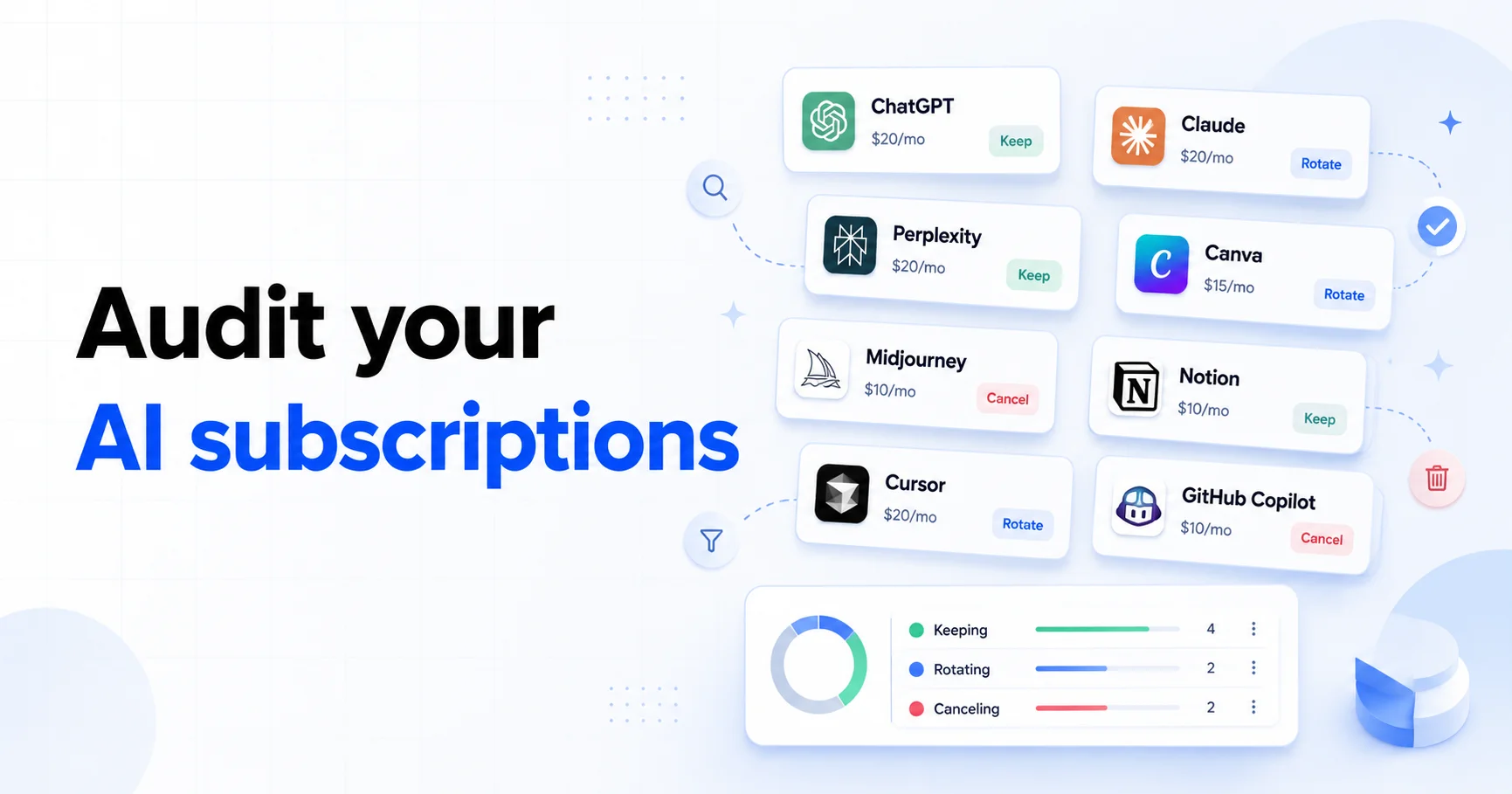
I Audited My AI Subscriptions in 2026: Which Tools Are Actually Worth Paying For?
AI subscriptions now stack up like streaming services. I reviewed my current AI tools, checked May 2026 pricing, and built a keep, cancel, or rotate framework for ChatGPT, Claude, Copilot, Cursor, OpenCode Go, GLM Coding Plan, and more.