Five Free Trials Ship With a New iPhone. They All Bill in the Same December Week.
Table of Contents
Setting up a new iPhone can start five separate three-month Apple trials on the same evening — Apple Music, Apple TV, Apple Arcade, Apple Fitness+ and Apple News+ — and because they start together they convert together, so a September setup produces five charges landing on one December day and $56.95 a month if you keep all of them.
Every roundup covers these offers one at a time: how to get three months of Apple TV, how to claim Apple Arcade. None of them frame the thing that actually costs money, which is that the offers are claimed in a single sitting and therefore share an expiry date. The trials are not five small decisions spread across the autumn. They are one decision you make on setup day and then forget for ninety days, and the reminder arrives as a bank charge in the most expensive week of the year.
Last reviewed: September 10, 2026. Every price and every deadline below was read from Apple's own pricing page and its per-service promotional terms, each linked at the point of the claim. US prices only; Apple states its offer terms per region, and it changes both, so open the linked source before you rely on a number.
What Actually Ships With the Phone
Apple keeps one page listing the trials attached to hardware purchases. On its hardware offers page it lists five, each at three months, each with slightly different eligibility. Apple Music and Fitness+ are for new subscribers; Apple TV and Arcade extend to "new and qualified returning subscribers".
The claim deadlines are the part nobody reads, and they are not written consistently. Apple's Apple Music promotional terms say the offer "must be claimed in the Apple Music app within 90 days after first setting up your new device". The Apple TV offer page says "you have 90 days after first setting up your device". The Apple Arcade offer page says 93. The Fitness+ terms and the News+ terms both say "within 3 months after first activating your eligible device". Those are not the same window. For a September setup, three calendar months is 91 days, so the Fitness+ and News+ deadlines fall a day after the Apple Music one, and Arcade gives you two days beyond that.
| Service | Free period | Where you claim it | Claim deadline, as Apple words it | Renews at |
|---|---|---|---|---|
| Apple Music | 3 months | Apple Music app | "within 90 days after first setting up your new device" | $11.99/mo |
| Apple TV | 3 months | Apple TV app | "90 days after first setting up your device" | $14.99/mo |
| Apple Arcade | 3 months | App Store | "93 days to activate" | $6.99/mo |
| Apple Fitness+ | 3 months | Fitness app on iPhone | "within 3 months after first activating your Eligible Device" | $9.99/mo |
| Apple News+ | 3 months | Apple News app | "within 3 months after first activating your eligible device" | $12.99/mo |
| All five | $56.95/mo |
The renewal prices come from Apple's own comparison of individual service prices, which is where Apple lists each service against the bundle. Apple Music's terms name the figure inside the offer itself: "Upon claiming the offer, you agree to a $11.99/month subscription that starts immediately after the free offer period and automatically renews until cancelled." The Apple TV, Fitness+ and News+ terms say "your region's price per month" instead, which is accurate and much easier to forget.
Why Five Trials Land in the Same Week
Nothing here is a trick. It is arithmetic. Each offer runs three months from the day you claim it, and setup day is when the phone puts all five in front of you: a card in the Apple TV app, a banner in the App Store, a prompt in Fitness the first time you open it. Claim them in one sitting, as most people do, and the five end dates are the same date.
Three months after mid-September is mid-December. That places the cluster in the fortnight when card statements are least legible, which is also the fortnight when an unexplained charge is least likely to be investigated. Our breakdown of what free trials actually cost over a year makes the general case; this is the sharpest single instance of it, because the timing is not accidental to the season, it is set by when phones are sold.
There is a second reason the December charge is hard to spot. Apple states that "several purchases might be grouped into one charge", adding that "in Europe and India, purchases might not be grouped". In the US that means five renewals can arrive as one APPLE.COM/BILL line of $56.95 that matches no receipt you can find. If a line like that has already caught you out, our decoder for unrecognised billing descriptors covers how to break a grouped Apple charge back into its parts.
The same page notes the order Apple charges in: it uses your Apple Account balance first, then your primary payment method. A gift card loaded at Christmas can absorb the first month of all five without a single line appearing on your card.
The Setup-Day Audit: What You Accepted, Not What You Were Offered
Do this while the phone is still new, because it takes ten minutes now and it is archaeology in December. Apple documents the path in its guide to cancelling an Apple subscription: Settings, tap your name, tap Subscriptions.
- Read the active list, not your memory. Migration flows, a restored backup and a Family Sharing organiser can all produce enrolments you did not consciously accept. The subscriptions screen is the record of what your Apple Account is actually signed up for.
- Tap into each entry and note the date. One line per service: name, the date shown, and the price it converts to from the table above. If you claimed Arcade a week after the rest, its end date is a week later than the rest, and the cluster becomes two clusters.
- Check the expired section too. It shows offers that already ran out, which tells you which of the five you have used before. The Apple Music terms allow "only one offer per Apple Account, regardless of the number of eligible devices you purchase". The Fitness+ and News+ terms are stricter still: "only one offer per Family, regardless of number of devices purchased".
- Check the second Apple Account. Households often have a media account and a personal account. Trials claimed under the other one never appear on this screen. The full sweep across accounts and stores is in our iPhone hidden-subscription audit.
What you want at the end is a five-row list with real dates on it, not five vague intentions to deal with it later.
Your Cancel-By Dates, Computed From Your Own Setup Date
Two deadlines matter. Apple's own floor is stated in its cancellation guidance: "if you signed up for a free or discounted trial subscription and you don't want to renew it, cancel it at least 24 hours before the trial ends." That is the last legal moment, not a plan. The workable date is earlier: our lead-time table for renewal reminders puts trials at three days out, measured from the trial end date, because the end date is the first-charge date rather than an expiry.
So: reminder at three days out, hard floor at one day out, and a decision window of about 48 hours in between. Applied to setup dates across the launch window, with all five offers claimed on setup day, that produces this:
| Setup day, 2026 | All five trials end and first charge lands | Apple's floor: cancel by | Put the reminder here |
|---|---|---|---|
| Friday 11 September | Friday 11 December | 10 December | 8 December |
| Friday 18 September | Friday 18 December | 17 December | 15 December |
| Friday 25 September | Friday 25 December | 24 December | 22 December |
| Thursday 1 October | Friday 1 January | 31 December | 29 December |
Read the third row again. A phone set up on 25 September has all five trials converting on Christmas Day, with the last safe cancellation on Christmas Eve. The fourth row is worse in a quieter way: a New Year's Day charge with a 31 December deadline is the one people miss, then dispute in January, then discover was correctly billed.
If you would rather not hand-build the calendar entries, our free trial reminder generator takes a trial end date and a lead time and produces a calendar file with the reminder and an all-day marker on the end date itself.
The Forfeiture Clause: Why Cancelling on Day One Is the Wrong Move
The obvious defensive move — cancel every trial the moment you claim it, keep the free months, avoid the charge — does not work with Apple. The published terms are explicit and near-identical. Apple Music: "If you cancel during your free offer period, you will immediately lose access to Apple Music and the remainder of your free trial. You can't reactivate this trial." Fitness+ and News+ carry the same clause and extend it to everyone sharing the offer: cancel early and "you and your family members will immediately lose access".
This is worth stating plainly because so much generic subscription advice says the opposite. With many merchants, cancelling early keeps the trial running to its end date. With Apple's device offers it burns it. The correct behaviour is the narrow window: use the full three months, decide two or three days before the end date, and cancel inside the last 48 hours before Apple's 24-hour floor.
One more clause changes the shape of the decision. The Music, Fitness+ and News+ terms each state that the offer "cannot be combined with Apple One". If you are already on an Apple One bundle, these offers are not available to you; if you switch to Apple One mid-trial, you are moving off the free plan you were on. That interacts with everything in our bundle ROI calculator, and it is the reason the bundle question belongs at the end of the trial rather than at the start.
Staggering the Claims So December Is Not One Big Bill
The claim window is the lever nobody uses. You have roughly 90 days to claim each offer, and the trial runs three months from the claim, not from the purchase. Claim everything on setup day and every charge lands in December. Claim selectively and the charges land wherever you decide.
- Claim on setup day only what you will genuinely use this autumn. For most people that is one or two of the five, not five.
- Hold the rest. A phone set up on 18 September can still claim Apple TV as late as 17 December under the 90-day window, and Arcade as late as 20 December under its 93. A trial claimed in mid-December runs to mid-March, well clear of the holiday statement.
- Never claim two on the same day. Two trials ending on the same date is one reminder you will read as one decision, and you will make the lazy version of it.
- Put the claim deadline in the calendar as well as the end date. The offers are use-it-or-lose-it, and one per Apple Account or per Family Sharing group depending on the service, so an unclaimed offer expires with nothing to show for it.
Here is what the do-nothing outcome costs, at the list prices Apple publishes:
| What renews if you never open Settings | Per month | Per year |
|---|---|---|
| All five device trials | $56.95 | $683.40 |
| iCloud+ 200 GB, taken during the restore | $2.99 | $35.88 |
| AppleCare One, monthly | $19.99 | $239.88 |
| Total | $79.93 | $959.16 |
That is an illustrative maximum for one person who claims every offer, takes the storage upgrade and buys device coverage monthly — not an average. But every line in it is a default the setup flow offers you, and the annual figure is larger than the price of a mid-range iPhone.
The bundle comparison is worth doing while you have the numbers open. Apple One Premier is $39.95 a month and includes all five services plus 2 TB of iCloud+, which costs $9.99 on its own. Keeping all five separately plus 2 TB comes to $66.94. If the honest answer in December is that you want to keep four or five of them, the bundle is $26.99 a month cheaper than the way the trials leave you.
The Two Recurring Costs No Trial Roundup Mentions
iCloud+. A free Apple Account gets 5 GB, which will not hold a modern iPhone backup. Apple's answer during migration is temporary free storage: its support page says you are eligible "if you buy a new iPhone or iPad and don't have enough iCloud storage to back up your current device", that you have 21 days to restore before the temporary backup is deleted, that you can request another 21 if the phone has not arrived, and that the backup survives 7 days after the restore. That is genuinely free and genuinely temporary. The paid upgrade prompted alongside it is neither: Apple's storage plan page lists 50 GB at $0.99, 200 GB at $2.99 and 2 TB at $9.99 a month in the US. If you accepted the paid plan when the temporary one would have done, that is a recurring charge created by a one-off migration.
AppleCare. Apple says that "when you purchase a new Apple device, and within 60 days of purchase, you can add AppleCare+ coverage", on a plan that "renews monthly or annually". It is not on the Subscriptions screen: Apple's own instructions send you to Settings, General, AppleCare and Warranty instead. AppleCare One, announced on 23 July 2025, is $19.99 a month in the US for up to three products, plus $5.99 a month for each device beyond that. Whatever you decide about it, decide deliberately: after the trial stack itself it is the biggest single line in the table above, and the 60-day window means you do not have to settle it on the day you buy the phone.
Both of these are the same failure mode as the trials: a recurring charge created by a one-time event, priced small enough not to argue with. Apple's commitment-plan mechanics, where a discount you accept once locks a term you cannot exit, are covered separately in our piece on Apple's 12-month commitment subscriptions.
When you are done, put the five dates somewhere that will interrupt you in December. A list you have to remember to open is not a reminder, which is the whole argument for tracking renewal dates rather than trusting that a $56.95 line will look strange enough to notice.
Sources and Scope
- Apple hardware services offers — the single page listing all five three-month device trials and their eligibility.
- Apple Music promotional terms (US) — the 90-day claim window, the $11.99 renewal, the Apple One exclusion, and the forfeiture clause quoted above.
- Apple TV three-month offer — "90 days after first setting up your device" and "plan automatically renews at your region's price per month until canceled".
- Apple: if you want to cancel a subscription — the Settings path, and the instruction to cancel a trial at least 24 hours before it ends.
- Apple: how apps, content and subscriptions are billed — grouped billing, the Europe and India exception, and the balance-first charging order.
- Apple One — the current US list prices for each individual service and for the three bundle tiers.
Alex Coca
Alex Coca is the independent developer behind SubBuddy. He researches subscription billing, cancellation patterns, and recurring-spend workflows by building the product and reviewing real subscription audits from users and his own accounts.
Put All Five Trial End Dates in One Place
Log each trial you actually claimed in SubBuddy with its end date and its post-trial price, and set the reminder a few days before the December cluster instead of the morning after it.
Track My Trials FreeRelated Articles
The Hidden Cost of Free Trials: How $0 Becomes $500/Year
That 'free' trial you forgot about? It's not free anymore. Discover how forgotten free trials are costing Americans an average of $500 per year and learn the exact steps to stop the bleeding.
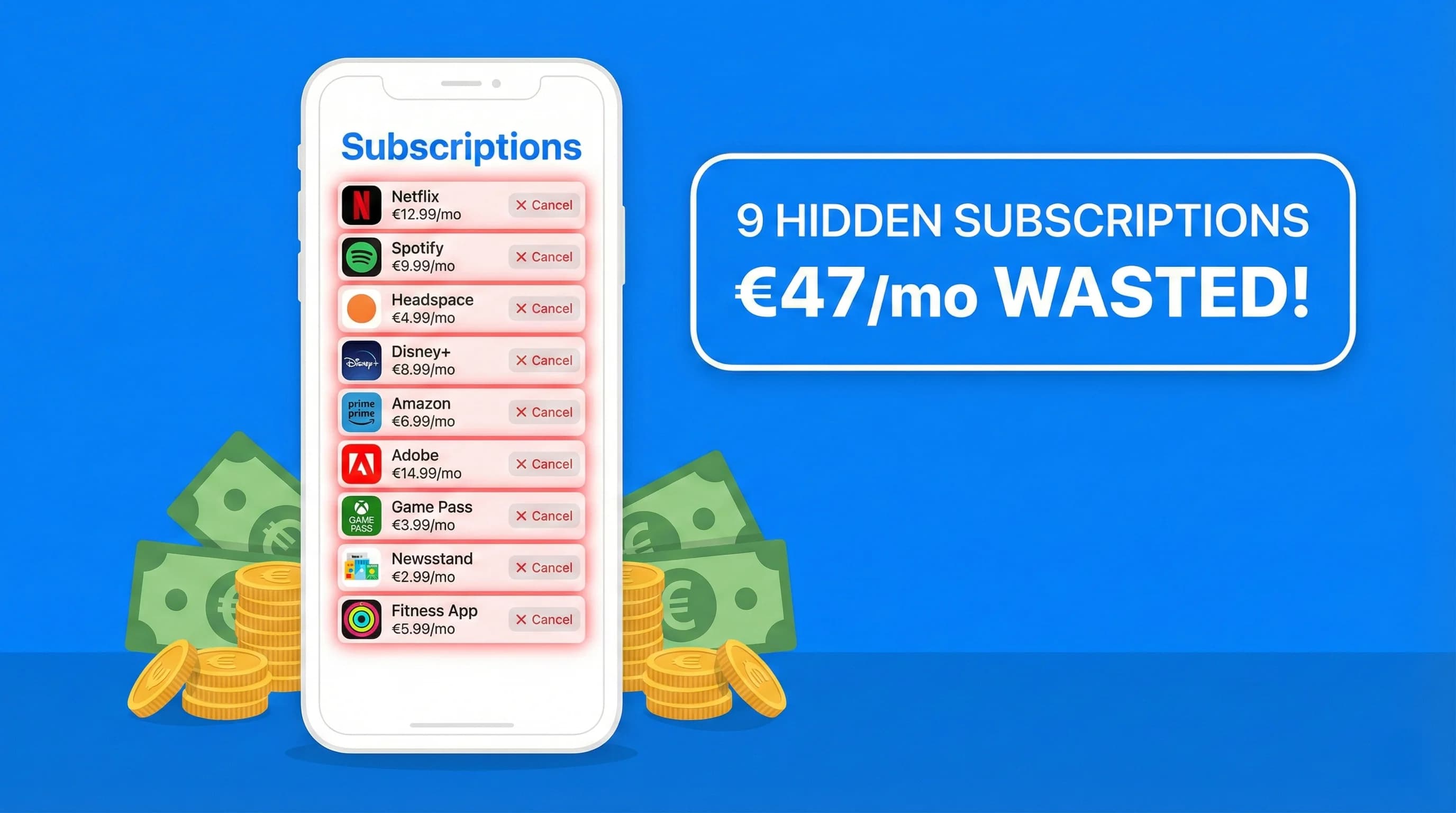
I Found 9 Hidden Subscriptions in My iPhone Bill in 10 Minutes: Here's Exactly How I Did It
Last Sunday I opened Subscriptions on my iPhone out of curiosity. Nine charges I'd totally forgotten were sitting there. Here's the exact 4-step process to find and kill every hidden subscription on your iPhone right now.
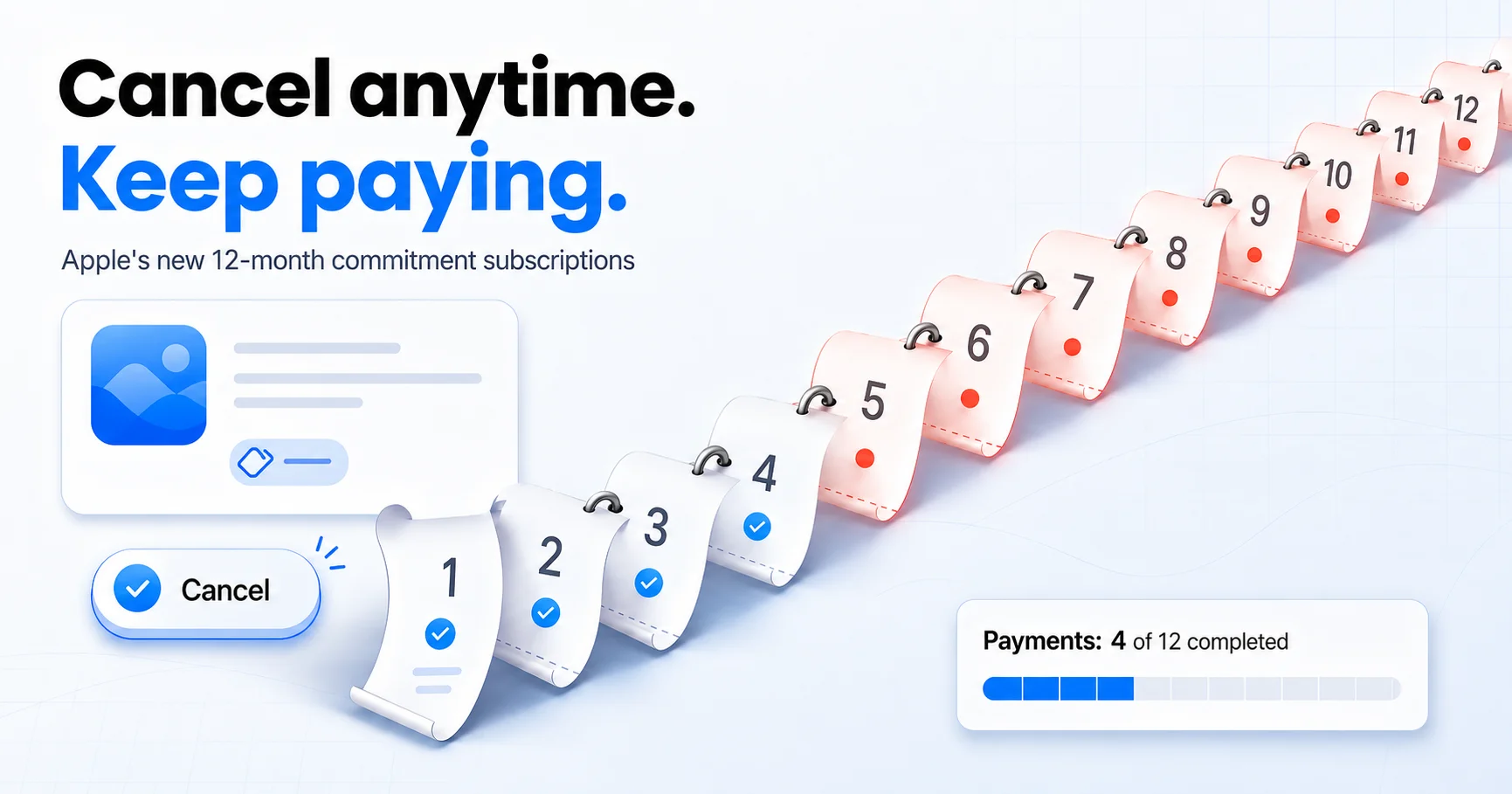
Cancel Anytime, Keep Paying: Inside Apple's New 12-Month Commitment Subscriptions
The App Store now sells monthly subscriptions with a 12-month commitment: a lower monthly price in exchange for a full year of payments that keep coming even after you hit cancel. Here is how the new plans work, why US readers do not see them yet, the walk-away math with real numbers, and a break-even rule for when the discount actually beats the lock-in.