The AI Tax: Software You Already Pay For Is Adding AI and Raising the Price in 2026
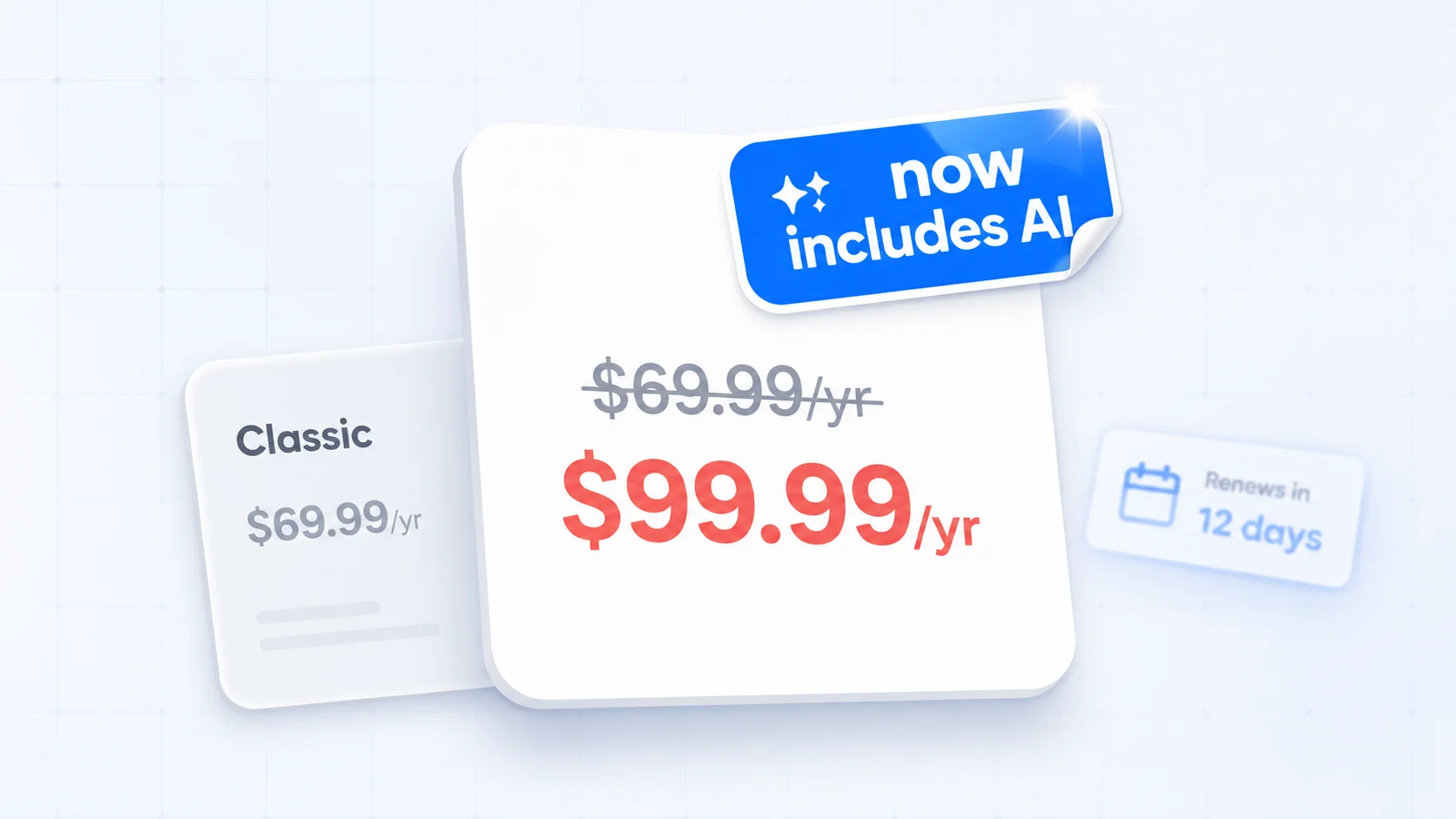
Table of Contents
Here is a subscription increase that does not show up in any price-hike tracker, because on paper nothing was "hiked." Your software did not raise its price. It added AI, gave the plan a slightly different name, and the new name happens to cost more. You did not choose the AI. You may never use the AI. But it is now baked into the plan you renew on autopilot, and the version without it is still for sale, just not anywhere you would look.
Call it the AI tax. In 2026 it is the quietest way your recurring bills are going up, and it is spreading across the most ordinary software in your stack: your office suite, your design tools, your cloud storage. This post maps which everyday subscriptions added an AI tax, what it actually costs you per year, where the cheaper AI-free version is hiding, and how to decide whether the AI is worth keeping or worth stripping out.
Last reviewed: June 18, 2026. Prices are US rates published by each company as of this date. Microsoft's consumer Copilot bundling and price increase landed in early 2025; its commercial suite increase takes effect July 1, 2026. Adobe renamed its all-apps plan in August 2025. AI bundling and pricing move quickly, so confirm the current numbers on each company's official plan page before you cancel or downgrade anything.
Methodology & Source Note:
Prices, plan names, and the existence of AI-free "Classic" or standard tiers are sourced from each vendor's official pages and dated reporting (linked in Sources). All figures are US consumer rates unless noted as commercial. The "AI tax" framing, the per-year cost math, and the decision test are mine, built for this post, not vendor figures. I write this as a developer who pays for these tools out of pocket and who genuinely uses AI daily, which is exactly why I think people should pay for it on purpose rather than by default.
What the "AI Tax" Actually Is
The AI tax is not one price increase. It is a pattern with three moving parts, and it is worth naming each one because the defense is different for each.
1. AI gets bundled into a plan you already pay for. Instead of selling AI as a separate add-on you opt into, the vendor folds it into the standard tier so that the only way to get the regular product is to also buy the AI.
2. The bundled plan costs more than the old one. The increase is presented as "new features," not a price rise, which is technically true and practically the same thing for your card statement.
3. The version without AI still exists, but it is hidden. Most of these vendors kept a cheaper, AI-free plan on the books. They just stopped showing it on the main pricing page, so you only find it if you go looking, or sometimes only when you threaten to cancel.
That third part is what turns a feature launch into a tax. If the AI-free plan were one click away on the pricing page, this would just be a choice. Because it is buried, the default path quietly costs you more, and defaults are what most people actually pay.
The June 2026 AI Tax Map
Here are the clearest current examples, what AI got added, the price before and after, and where the cheaper path is hiding. All figures are US consumer rates unless marked.
| Subscription | AI that was added | Price before → after | The cheaper AI-free path |
|---|---|---|---|
| Microsoft 365 Personal | Copilot + monthly AI credits | $69.99 → $99.99/yr (+$30, +43%) | Personal "Classic" at $69.99/yr, hidden in account settings |
| Microsoft 365 Family | Copilot for the primary account | $99.99 → $129.99/yr (+$30, +30%) | Family "Classic" at $99.99/yr, hidden in account settings |
| Adobe Creative Cloud (All Apps) | 4,000 monthly Firefly generative credits | Renamed "Creative Cloud Pro," price raised | "Creative Cloud Standard," fewer credits, must be requested |
| Google Gemini AI Ultra | Bundled YouTube Premium individual | $99.99/mo tier (new middle rung) | AI Pro at $19.99/mo if you do not need the bundle |
| Microsoft 365 (commercial) | More AI, security, and management baked into core suites | Increase effective July 1, 2026 | Lock current rates before June 30, 2026 on annual terms |
Two of these are precise dollar increases you can verify on a statement. The other two are structural: a rename and a new middle tier that change what the default plan includes and what it costs. The pattern is the same in every row. The AI is the reason given. The higher price is the result.
Microsoft 365: The Cleanest Example
Microsoft 365 is the textbook case because the numbers are public and the opt-out is real but hidden. In early 2025 Microsoft raised US consumer prices for the first time in over a decade and used Copilot as the reason. Personal went from $69.99 to $99.99 a year. Family went from $99.99 to $129.99 a year. That is $30 more a year in both cases, which is a 43% jump on Personal and 30% on Family for an AI assistant many subscribers had not asked for and some had never opened.
Here is the part that makes it a tax rather than a choice. Microsoft kept the old plans alive as "Microsoft 365 Personal Classic" and "Family Classic" at the original prices, with no Copilot. They are not on the main pricing page. You typically only see them inside account management, and they are most likely to surface at the exact moment you start a cancellation. In other words, the cheaper plan is treated like a retention offer rather than a listed option, which is the same playbook streaming services use with their cancellation save offers.
If you use Copilot inside Word, Excel, and Outlook regularly, the new plan can be a genuinely good deal, since standalone AI assistants cost more than $30 a year on their own. If you do not, the Classic plan gets you the identical Office apps and 1TB of storage for $30 less per user per year. That is the whole decision: are you using the AI, or just paying for it.
The 2026 deadline: the consumer change already happened, but Microsoft's commercial suite prices rise on July 1, 2026, again bundling more AI and security into the core plans. For businesses, the practical move is to lock current rates on an annual commitment before June 30, 2026, then decide on the AI tiers deliberately at renewal rather than being moved up automatically. This is exactly the kind of dated, fast-moving software pricing that belongs in a small-business SaaS audit.
Adobe: AI Credits You May Never Spend
Adobe took a softer version of the same path. In August 2025 it renamed its Creative Cloud All Apps plan to "Creative Cloud Pro" and built in 4,000 monthly Firefly generative AI credits as a standard entitlement, with a price increase attached. The credits are useful if you generate images and effects with Firefly. If you mainly use Photoshop and Lightroom the traditional way, they are a feature you are funding and not spending.
Adobe does keep a lower "Creative Cloud Standard" tier with fewer generative credits, but like Microsoft's Classic plans, it is not the option waved in front of you, and in some cases it has to be requested rather than selected from a menu. The lesson generalizes: when a vendor switches from "AI is an add-on" to "AI is included," look immediately for the standard or classic variant, because it usually still exists at a lower price.
When the AI Is a Bundle, Not a Feature
The sneakiest version of the AI tax is not an AI feature at all. It is a second subscription tucked inside the AI plan. Google's Gemini AI Ultra at $99.99 a month bundles a YouTube Premium individual plan. If you already pay for YouTube Premium separately, that bundle is a real saving. If you do not, it is an upsell dressed as value, and it can quietly turn into a double charge if you sign up for Ultra and keep your old YouTube Premium running. We broke down the full Gemini ladder and where that overlap bites in the June 2026 Gemini plan map.
The rule for any bundled subscription inside an AI plan is the same: it only counts as savings if you were already paying for it on purpose. Otherwise you are not getting a free extra, you are being talked into a tier you did not need by attaching something you would not have bought.
Why the Opt-Out Is Always Hidden
None of this is an accident, and understanding the mechanism makes it easy to beat. Companies know that defaults win. The vast majority of subscribers never change the plan they are placed on, so whatever the default tier is becomes what most people pay, regardless of what they use. By making the AI-bundled plan the default and the AI-free plan something you have to hunt for, a vendor can raise the effective price for almost everyone while still being able to say, accurately, that a cheaper option exists.
Surfacing the cheaper plan only during cancellation is the same idea taken one step further. It converts the AI-free price into a retention tool, so you are rewarded for almost leaving rather than for simply choosing what you want. It works because most people never get that far. The defense is not outrage, it is a habit: whenever a subscription tells you it "now includes AI," assume a cheaper version exists and go find it before you renew.
The AI Tax Test: Are You Actually Using It?
Run this on any subscription that recently added AI. It takes about two minutes per service.
- Did the price go up, or the plan name change? If your renewal amount rose or the plan got a new name in the last year, AI bundling is the likely reason. Note the old price and the new one.
- Do you use the AI at least weekly? Be honest about real use, not intent. Opening Copilot once to try it is not weekly use. If you genuinely lean on it, the bundle may be worth it.
- Is there a Classic or Standard version? Check account settings, not just the marketing pricing page. If a cheaper AI-free plan exists, write down the gap.
- Multiply the gap by every seat and every year. Thirty dollars a year sounds trivial until it is five family members, or a five-year habit, or a dozen company seats. The annual, all-seats number is the one that should drive the decision.
If you use the AI weekly, keep the bundle and stop feeling bad about it. If you do not, and a cheaper tier exists, the AI tax is pure leakage and you should strip it out.
What To Do This Week
- List every subscription that added AI in the last year. Office suite, design tools, note apps, cloud storage, anything that recently announced an "AI" or "Copilot" or "Pro" plan.
- For each one, find the Classic or Standard tier. Look inside account settings, and if it is not there, start a cancellation flow to see whether the cheaper plan appears as a save offer.
- Apply the AI tax test. Weekly use means keep. No real use plus a cheaper tier means downgrade.
- Lock annual rates before deadlines where they matter. For Microsoft 365 commercial plans, that means committing before the July 1, 2026 increase.
- Record the result so it does not creep back. Note the plan you chose and its renewal date, because the default will keep trying to move you back up at renewal.
Why This Belongs in Your Subscription Tracker
The AI tax is hard to catch precisely because it does not look like a new charge. It hides inside subscriptions you already approved, under feature names rather than price changes, which is what makes it slip past a casual glance at your statement. The fix is the same discipline that catches every other quiet increase: record the exact plan name and price for each subscription, note the cheaper AI-free alternative next to it, and re-check at renewal when the number is most likely to have moved.
This is the same muscle behind the broader AI subscription audit and the shift to metered AI we covered when Anthropic put Claude's agents on a meter. AI spend has stopped being a couple of flat fees and become a moving target spread across tools you do not think of as "AI products" at all. If you want a fast way to see what an AI tax actually costs over a year, our subscription cost calculator turns a small monthly or per-seat increase into the annual figure, which is usually the number that makes the decision for you.
The Quick Checklist
- The AI tax is AI bundled into an existing plan, a higher price, and a hidden AI-free option.
- Microsoft 365 Personal went from $69.99 to $99.99 a year and Family from $99.99 to $129.99 a year when Copilot was added.
- Cheaper "Classic" plans still exist but live in account settings and often only appear at cancellation.
- Adobe's Creative Cloud Pro folds in 4,000 Firefly credits you may never spend; a lower Standard tier exists.
- A bundled subscription inside an AI plan, like YouTube Premium in Gemini Ultra, only saves money if you already pay for it.
- Use the AI weekly? Keep it. If not, and a cheaper tier exists, strip the AI tax out and log the change.
Sources
- Microsoft: 2026 Microsoft 365 packaging and pricing updates (official, commercial increase July 1, 2026)
- AppDirect: Microsoft 365 prices are changing, lock current rates by June 30
- Office Watch: Microsoft 365 plans overview, including Personal and Family "Classic" pricing
- Adobe: Changes to Creative Cloud individual plans (official)
- Google: Everything new in our Google AI subscriptions (official)
Alex Coca
Founder & CEO of SubBuddy and a daily user of AI tools. Alex writes practical subscription frameworks for people who want to pay for the features they actually use, not the ones a default plan chose for them.
Catch the AI Tax Before It Renews
Track every subscription in SubBuddy with its exact plan and price, note the cheaper AI-free alternative next to it, and set renewal reminders so a bundled price increase never slips past you again.
Start Tracking FreeRelated Articles
I Audited My AI Subscriptions in 2026: Which Tools Are Actually Worth Paying For?
Once you have stripped out the AI tax, audit the AI you do pay for on purpose. Here is the keep, cancel, or rotate framework across every tool.
Google Just Cut Gemini's Price and Reshuffled Every Tier: The June 2026 AI Plan Map
The Gemini Ultra tier bundles YouTube Premium, the textbook example of an AI plan hiding a second subscription you may already pay for.
Anthropic Put Claude's AI Agents on a Meter: What the June 15 Credit Change Actually Costs You
AI spend has stopped being a flat fee. The metered shift is the other half of why AI costs are now a moving target across your stack.