Pause or Cancel? We Re-Checked All 49 Services We Track, and 11 Let You Stop Billing Without Losing the Account
Table of Contents
Eleven of the 49 services we track publish a real billing pause: a documented state where the charge stops and the account survives. The other thirty-eight offer one exit only, cancellation. Which group your subscription sits in decides whether taking three months off is free or costs you the plan you are grandfathered into.
Nobody publishes a cross-service answer to the only question that matters here: which of my subscriptions can actually do this? Each operator buries it in its own help centre, often inside the cancellation flow, and the aggregator articles are mostly wrong or three years stale. So we read the documentation for every service we maintain a guide for, all 49, and wrote down the length, the menu path and the exclusions for each one.
Last reviewed: September 2, 2026. Every pause length, location and exclusion below was read from the operator's own help page between 26 and 28 August 2026, on US-billed consumer plans unless noted. "Real pause" means the operator documents a state in which billing stops and the account survives. Availability and exclusions change often and vary by country and billing channel, so check the service's own page before relying on this.
The Result: 11 of 49
Eleven services document a real billing pause. Thirty-five document cancellation only. That is roughly one in four, and the eleven are not the ones you would guess: two food-delivery memberships and a fitness wearable make the list, while most of the big streamers and every AI subscription we track do not.
The audit also corrected our own data. Our service guides had recorded a pause on six of them, Hulu, YouTube Premium, Peloton, Canva, Audible and Amazon Music Unlimited. Re-verification found five more, Netflix, Disney+, WHOOP, Uber One and DashPass, and found that Canva's pause has changed shape since we last looked: it is now a fixed three months reached only through the cancellation flow, not a one-to-three-month choice on the billing screen. Those corrections are flowing back into the service guides.
Where the Pause Button Actually Hides
This is the part the support pages never collect in one place. Four of the eleven are not on a screen labelled pause at all: Netflix, Amazon Music Unlimited and Canva keep theirs inside the cancellation flow, and YouTube files its under Deactivate.
| Service | How long | Where the control is | The catch |
|---|---|---|---|
| Netflix | One month at a time, three months total | Account → Cancel Membership → Pause for 1 Month | Not on the Basic plan, and not with direct debit, gift cards or some partner billing. A week before it resumes you are offered one more month; at the end you are charged the price of your current plan |
| Disney+ | You choose the length | Account → your subscription → Pause subscription | Monthly, Disney-billed plans only; minimum-term and some promotional plans are excluded. A bundle pauses with you, so does the Extra Member profile, and resuming early bills you immediately |
| Hulu | Up to 12 weeks | Account → Your Subscription → Pause | Not for annual plans, gift cards, promotions, accounts already on hold, or third-party billing (Amazon and Roku excepted). It "will resume automatically after the specified duration" and bill "on a recurring monthly basis", with no promise about the rate |
| YouTube Premium | 1 to 6 months | youtube.com/paid_memberships → Manage membership → Deactivate → Pause | Annual plans cannot pause, and neither can accounts billed through Apple. The pause begins after the current billing cycle, and you are "billed at the new price" when you resume |
| Amazon Music Unlimited | Not published; it resumes on its own, or when you resume it | Amazon Music Settings → Amazon Music Unlimited → Cancel, then take the pause option | Blocked on annual plans, free trials, promotions and Apple, Google or carrier billing. Individual and Family account holders lose the included audiobook at the end of the cycle whether they pause or cancel |
| Audible | Up to 90 days per rolling 12 months | Account Details → Pause membership | You keep and can spend existing credits but earn no new ones, and a discounted promotional period keeps counting down while you are paused, so the promo dies during the break |
| Canva | Exactly 3 months | Settings → Billing → Cancel plan → Continue cancelation → I want to pause my subscription | Reachable only through the cancellation flow; on an annual plan only within two months of renewal; "pausing a plan is not available from the iOS App Store" |
| Peloton All-Access | 1, 2 or 3 months | onepeloton.com/mymembership → Manage → Pause or cancel | No content at all during the pause, on the Bike, Tread, Row or in the app. The pause starts at your next billing cycle, and Peloton recommends cancelling instead if you will be away longer than three months |
| WHOOP | Up to 3 consecutive months, once every 12 | app.whoop.com → Membership → Pause Membership | Not during a commitment period, and not on Family plans. Unusually, the pause takes effect immediately rather than at the next cycle, and prepaid membership time is preserved |
| Uber One | 1 or 2 months, four times a year | Account → Uber One → Manage Membership → Pause membership | Monthly plans with auto-renew on, only. Annual, free-trial, business and partner-sponsored accounts are excluded |
| DashPass | Not published | Manage DashPass → Pause Membership | DoorDash documents the button and the confirmation dialog and never says how long the pause runs |
The other thirty-eight run from a polite no to a documented one. Headspace is the cleanest example of the latter: "We do not currently offer the option to pause your subscription. However, you can disable the auto-renewal feature." Max, Paramount+, Peacock, Apple TV+, Spotify, Apple Music, Tidal, Adobe Creative Cloud, Microsoft 365, Notion, Figma, 1Password, NordVPN, Duolingo, Calm, Strava and every AI subscription we track, ChatGPT Plus, Claude Pro, Midjourney, Cursor and GitHub Copilot, publish cancellation and nothing else. Prepaid game passes (Xbox, PlayStation Plus, Nintendo Switch Online) have no pause by construction: you already bought the time.
The pause that lives at the store, not the service
There is a second place a pause can live, and it explains several of the exclusions above. Google Play can pause an eligible subscription for one week to three months, at the end of the current billing period, if the developer turned the feature on. An Android-billed subscription can therefore sometimes be paused even when the service itself has no pause of its own, which is worth checking during a Google Play subscriptions audit.
Apple has no equivalent. Its subscription page documents cancelling and nothing else, and the operators say the same from their side: YouTube blocks pausing for Apple-billed accounts, Canva states plainly that pausing is unavailable from the iOS App Store, and Amazon excludes Apple, Google and carrier billing outright. An operator cannot pause a charge it does not raise. If you want the option at all, subscribe on the web, which is usually the cheaper rail anyway.
Four Things That Look Like a Pause and Are Not
- Turning off auto-renew. That is a scheduled cancellation. The account ends on the renewal date and does not come back on its own. Headspace explicitly offers this instead of a pause.
- A retention discount. "Stay for three months at 50% off" is not a pause. You keep paying, just less, and the clock on the discount belongs to the merchant. That is a different negotiation, covered in the retention offer playbook.
- Cancelling and rejoining later. A perfectly good strategy, and the whole basis of the rotation playbook, but not a pause, because nothing is preserved except whatever the service chooses to keep.
- Marking it "paused" in a tracker. Dangerous enough to get its own section below.
The Rule Nobody States: A Pause Does Not Save You Money
Here is the part most articles get backwards. During the break, pausing and cancelling cost exactly the same amount: zero. Both stop the charge. So the question is never which one saves more. It is what coming back costs you.
A pause buys a cheaper return, and it costs you two things in exchange:
- The restart decision. A pause resumes on the merchant's date at the merchant's current price, whether or not you still want it. A cancellation makes you decide again, which is a feature.
- The win-back offer. Retention and win-back discounts are aimed at people who are leaving. Pause and you have told the merchant you are coming back, which is the one message that makes a discount unnecessary.
So the rule is: pause only when returning after a cancellation would cost you something real, and your break fits inside the cap. "Something real" is a short list. A grandfathered price you cannot get again, prepaid months you would forfeit, balances that expire on cancellation, a joining or activation fee, or hours of re-onboarding. If none of those apply, cancel and rotate.
Four Worked Decisions
Audible, three unused credits: pause wins
Premium Plus is $14.95 a month. Unused credits die when you cancel; they survive a pause, and Audible confirms you can keep spending them while paused, though you earn no new ones. Three credits are roughly $45 of audiobooks you have already paid for, against a cap of 90 days that comfortably covers a summer. Pause, spend the credits during the break, then decide. One warning straight from Audible's page: a discounted promotional rate keeps counting down while you are paused, so the promo dies either way.
Netflix, a four-month break: cancel wins
Standard is $19.99 a month after the March 2026 increase. Netflix pauses one month at a time and stops at three months total, so a four-month break puts you back on the bill in month four unless you go and act. Cancelling costs the same nothing, and Netflix keeps your viewing activity for 24 months after an account closes, so the personalisation you would be protecting is not actually at risk. Cancel, and rejoin when there is something you want to watch.
Peloton, a three-month injury: pause wins on convenience, not money
All-Access is $49.99 a month. Three months paused and three months cancelled both save $149.97. The pause wins because it restarts itself when you are ready and keeps the hardware out of the stripped-back mode a cancellation triggers. But note what Peloton's own documentation says: if you expect to be away for more than three months, cancel and reactivate. When the operator tells you to cancel, believe it.
WHOOP, a prepaid annual membership: pause wins outright
WHOOP One is $199 a year, charged up front. Cancelling mid-term does not hand back the months you already bought; pausing, in WHOOP's words, lets you "retain any remaining membership time" and pushes the billing date out. This is the clearest case in the audit, and it generalises: anywhere you have prepaid, a pause is worth real money and a cancellation is worth nothing. It is also why so many pauses exclude annual plans, and why the handful that do not are worth knowing about.
Notice what all four have in common: the monthly price never decides it. What decides it is the shape of the plan you are on and what you would lose on the way out. Prices here are the US list prices in our service guides, re-verified on 26 August 2026.
The Two Traps
Trap 1: the pause that resumes at a price you never agreed to
Read the operators' wording side by side and the pattern is obvious. YouTube: you are "billed at the new price" when you resume. Netflix: at the end of the pause you are charged the price of your current plan. Hulu: your subscription "will resume automatically after the specified duration" and your card is charged "on a recurring monthly basis". None of them promise the price you paused at.
A pause protects the account, not the rate. If an increase lands during your break, and 2026 has been a heavy year for them, you come back onto the new number at exactly the moment you are not thinking about the subscription, because the whole point of pausing was to stop thinking about it.
The fix is one line of admin: record the resume date the moment you pause, and set the reminder before it, not on it. Our lead-time table for renewal reminders applies here unchanged, because a resume date is a renewal date wearing a friendlier name. And if a charge you do not recognise lands a few months after a pause, the billing descriptor decoder will usually identify it faster than your bank's app will.
Trap 2: a tracker pause is a note to yourself, not a stopped charge
This one is worth being blunt about, because it applies to our own app.
SubBuddy models four lifecycle states, active, paused, canceled and trial, and a subscription marked paused behaves very specifically in the code: it contributes zero to every spend total, it is filtered out of the calendar export, and the renewal email and push jobs skip it. That is correct behaviour for a subscription genuinely paused at the biller, and exactly the wrong behaviour for one that is not.
So the failure mode writes itself. You decide to pause Hulu, you mark it paused in the tracker, you never finish the flow on Hulu's site, and now the charge still lands every month while the one system that would have warned you has been told to stay quiet. A tracker pause is a note to yourself. A biller pause is a stopped charge. Same word, two unrelated events.
The discipline is simple, and it is the same one that makes a subscription spreadsheet trustworthy: change the state in your tracker only after you have seen the confirmation on the merchant's site, and write the resume date into the row at the same moment. SubBuddy has no bank connection and never guesses at your billing, so the state in it is exactly as accurate as the evidence you put behind it.
What This Means in the First Week of September
Early September is the week of the year when this decision comes up across a whole portfolio at once. The summer-only services have done their job, and the sports and gym subscriptions are about to restart. Three moves, in order:
- Pause what you will genuinely want back before Christmas, such as the fitness membership you stopped using in July or the design tool between projects. Check the cap first: three months from early September lands in early December, which is inside every cap in the table except Hulu's 12 weeks and Uber One's two months.
- Cancel what you are only keeping out of inertia. If nothing on the cost-of-returning list applies, there is no argument for pausing, and cancelling puts you into the rotation and within reach of a win-back offer.
- Leave alone what you are actively using. The autumn line-up is the part of the year where the streaming value comparison tends to argue for keeping rather than cutting. A pause you reverse in three weeks is churn with extra steps.
And if a service you want to leave has no pause at all, that is not a dead end. It is the ordinary cancellation problem, and the platform-by-platform cancellation guide has the steps.
Sources and Scope
Every pause length, location and exclusion above was read from the operator's own documentation between 26 and 28 August 2026:
- Netflix: how to cancel Netflix for the one-month pause, the three-month total, the plan and payment-method exclusions, and the price on resumption.
- Disney+: how to cancel Disney+ for pause eligibility, the chosen duration, minimum-term exclusions and Extra Member behaviour.
- Hulu: can I put my Hulu subscription on pause? for the 12 weeks, the exclusion list and the automatic monthly resumption.
- YouTube: pause or resume YouTube Premium for 1 to 6 months, no annual plans, no Apple billing, and billing at the new price.
- Amazon: cancel your Amazon Music Unlimited subscription for the pause offer inside the cancel flow, its four exclusions and the audiobook note.
- Audible: pause your membership for 90 days per 12 months, the credit rules and the promotional-rate warning.
- Canva: pause a Canva plan for the fixed three months, the cancellation-flow route and the iOS App Store exclusion.
- Peloton: managing your All-Access Membership for 1 to 3 months and the advice to cancel beyond that.
- WHOOP: pausing your membership for three consecutive months once every 12, the commitment and Family-plan exclusions, and retained membership time.
- Uber: how to pause my Uber One membership for one or two months, four times a year, monthly plans only.
- DoorDash: how do I cancel my DashPass subscription? for the pause steps, published without a duration.
- Google Play: cancel, pause, or change a subscription for one week to three months, at the developer's discretion.
- Headspace: can I pause my subscription? for the documented no.
- Apple: if you want to cancel a subscription from Apple for the absence of any pause on that rail.
Services with no pause were recorded as such because their own help documentation describes cancellation only; the absence of a documented pause is not proof that a retention agent will never offer one. Prices are US list prices from our service guides, last re-verified 26 August 2026.
Alex Coca
Alex Coca is the independent developer behind SubBuddy. He researches subscription billing, cancellation patterns, and recurring-spend workflows by building the product and reviewing real subscription audits from users and his own accounts.
Track the Resume Date, Not Just the Renewal Date
A paused subscription has a date it comes back to life, usually at a price you did not agree to. Keep every subscription, its state and its next billing date in SubBuddy, and get told before the pause ends.
Start My Subscription ListRelated Articles
The Subscription Rotation Playbook: How to Watch Everything for $15–30/Month in 2026
Many Americans pay for streaming services they don't use every month. The smartest consumers in 2026 aren't canceling. They're rotating. Here's the exact month-by-month playbook to watch everything you want across Netflix, Disney+, Max, and more while never paying for more than 1–2 services at a time.
The Complete Guide to Canceling Subscriptions on Every Platform (2026)
Canceling subscriptions should be simple, but companies make it intentionally difficult. Here's your step-by-step guide to canceling subscriptions on every major platform, from Apple to Amazon.
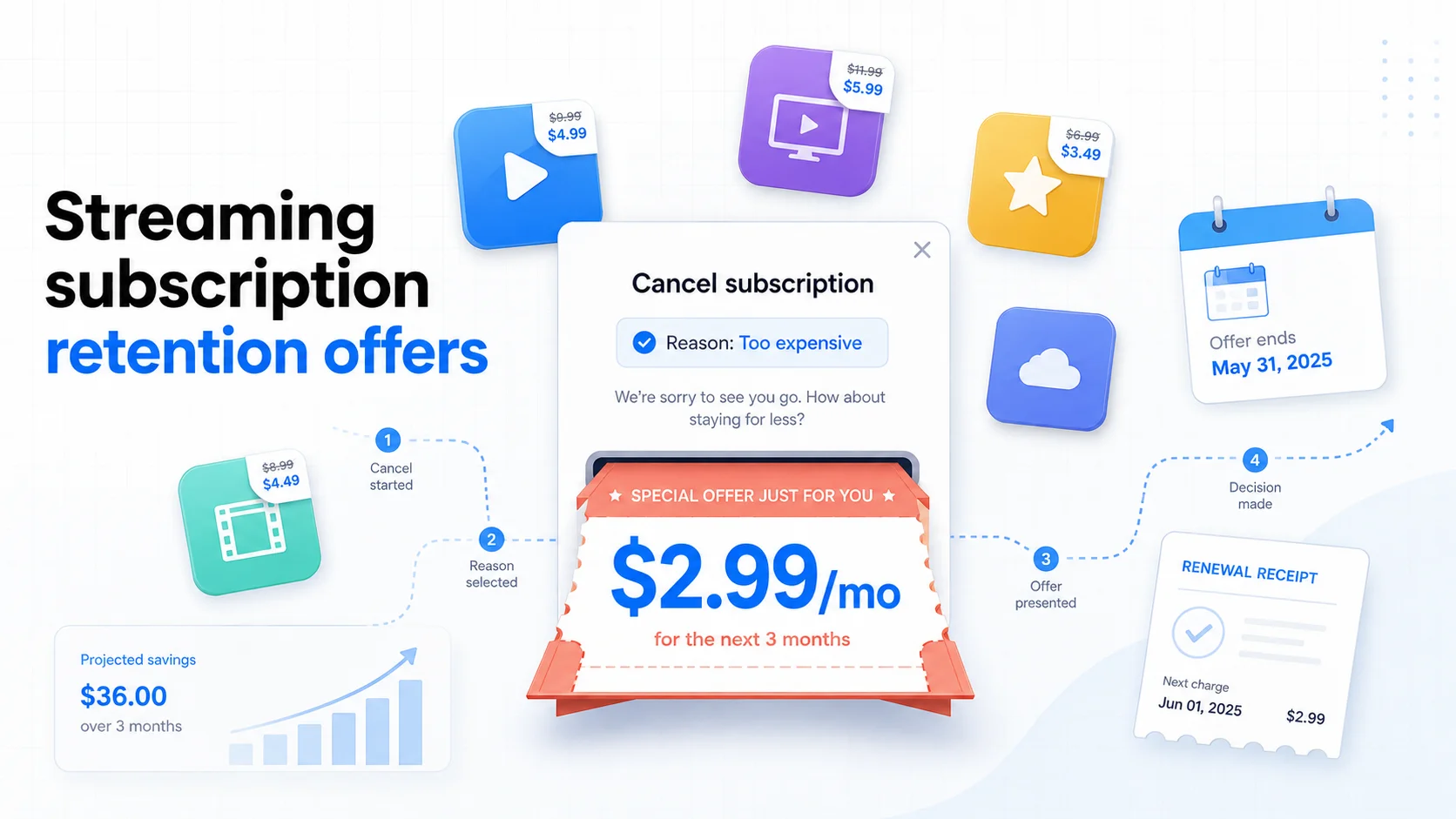
The Subscription Retention Offer Playbook: What Streaming Services Actually Offer When You Try to Cancel (2026 Edition)
Hulu, Peacock, Max, Apple TV+, Disney+, Paramount+, YouTube Premium, and Spotify all show retention discounts inside their cancellation flow. Netflix and Amazon Prime Video do not. Here is the 2026 playbook for triggering the best offer, when to accept it, and how to chain offers into a 6-month rotation.