Your Renewal Price Was Set by an Algorithm: How to See It and What to Do
Table of Contents
When a renewal notice carries the sentence "THIS PRICE WAS SET BY AN ALGORITHM USING YOUR PERSONAL DATA", that is a disclosure New York has required since November 10, 2025 — and it means the amount you are about to be charged was computed for you rather than published for everyone. It does not mean you are being overcharged, and its absence does not mean you are not. What it does is turn a suspicion into something you can act on.
What follows: what the label establishes, where your genuine next-charge number lives on each billing channel, and a decision rule for what to do once you have all three of the numbers that matter. Our guide to the window between a price-hike announcement and your own bill handles the timing side; this one is about the number itself.
Last reviewed: September 17, 2026. Statutory text read at the New York Senate's law database; app-store rules taken from Apple's and Google's own developer documentation; storefront prices checked on August 28, 2026 and every other price attributed to the source linked beside it. This is consumer guidance, not legal advice.
The Label and the Law Behind It
New York's Algorithmic Pricing Disclosure Act sits at General Business Law § 349-a. Where a business uses what the statute calls personalized algorithmic pricing — dynamic pricing produced by an algorithm that relies on personal data linked to a specific consumer or device — it must make a clear and conspicuous disclosure in the same medium as the price, on, at or near and contemporaneous with the offer, using that exact sentence. The wording is not the seller's choice. That is why the line reads so strangely inside an otherwise ordinary marketing email.
The law took effect on November 10, 2025, and survived an immediate First Amendment challenge: the National Retail Federation argued that the mandated sentence was compelled, misleading speech, and the Southern District of New York rejected that, holding the disclosure reasonably related to the state's interest in informing consumers. The trade group appealed, and the Washington Legal Foundation filed a supporting brief at the Second Circuit on January 13, 2026. Enforcement sits with the Attorney General, who has to send a cease-and-desist letter and allow a cure period first, and civil penalties run to $1,000 per violation. Announcing the law, Governor Hochul framed it as shining a light on "hidden online pricing tactics".
Nothing in it bans the practice. It is a labelling law, and a state one: the obligation runs to consumers in New York. Two people on the same plan, one in Brooklyn and one in Boise, can receive the same computed price and only one of them sees a line explaining where it came from.
That division of labour may not last. New York's legislature passed the One Fair Price Act (S.8623B / A.9349B) in June 2026, which would prohibit setting an individual's price from personal data instead of merely labelling it, with penalties of up to $5,000 for a first violation and $20,000 for later ones. When we checked in late August 2026 it was still waiting on the Governor's signature, and its own text delays it to the 180th day after it becomes law — so it will not touch this autumn's renewals either way. Other states moved faster and narrower: Maryland went first in 2026 with a ban covering food retailers and delivery apps, and Colorado and Connecticut followed with broader bills. Subscriptions sit outside most of that drafting.
What the Label Actually Proves
Read the statute's exemptions and the label gets more informative, not less. Along with carve-outs for insurers, for financial institutions regulated under the Gramm-Leach-Bliley Act, and for location data used only to work out a fare in a for-hire or ride-hailing vehicle, § 349-a exempts a price offered to a consumer who already holds a subscription contract when that price is lower than the one set out in that agreement. A genuine retention discount, in other words, does not need the label.
So if the sentence turns up beside a renewal price, the most useful inference is the one the seller did not intend: this offer is probably not a cut below your contracted rate. It could be your existing price recalculated, or an increase. The hedge is that some companies apply the disclosure across the board to avoid arguing about edge cases, which is a rational compliance choice. Treat the label as a strong prompt to check the number, never as proof of a specific outcome.
| What you see | What it supports | What it does not support |
|---|---|---|
| The disclosure on a renewal offer | Personal data fed an algorithm that produced this price, and the offer is unlikely to be a discount below your contract rate | That you are paying more than other customers, or that the price is unlawful |
| No disclosure at all | Nothing about how the price was set | That the price is uniform — you may simply be outside New York |
| A price that changes when you switch device or browser | Segmentation of some kind is running | That personal data was used; storefront, currency and tax routing do the same thing |
| A cheaper price for new customers | Ordinary promotional pricing | That an algorithm was involved at all |
The last two rows matter because most price differences people notice are not algorithmic at all. Reach the Wall Street Journal's subscribe page from a European connection and you land on its EMEA storefront: WSJ Digital at €2 a month for the first year against a €9.99 standard rate, the Digital Bundle at €4 against €18.99, and a line saying print editions are not available in your country (checked August 28, 2026). That is location routing, and no disclosure law reaches it. The same page states the rule that actually governs most renewals: introductory prices "are our lowest available rates, and are available only to new subscribers", after which a subscription "will automatically renew each month at the standard price for your package".
When Renewal and Advertised Prices Are Simply Different Numbers
The label surfaced in news subscriptions first. Nieman Lab reported in July 2026 that renewal notices from Wired, NJ.com and the Wall Street Journal had begun carrying the mandated sentence, and its reporting included a concrete pair of numbers: one subscriber's print-and-digital renewal ran at $76.99 every four weeks, which is $19.25 a week or $923.88 a year, while the price on the Journal's own site worked out to $16.25 a week, roughly $845 a year, after a first year at 40% off. Dow Jones's response was that it uses subscriber data responsibly under governance and compliance protocols — a statement about process, not about the gap.
The sharper illustration in that reporting was NJ.com rather than the Journal. One subscriber posted a renewal notice putting his annual price at $130; others answering him reported $145 and $175, on a site whose published tiers start at $100 for a basic annual subscription and $200 for premium. Same masthead, same season, four different numbers — and the only reason those subscribers could compare notes is that a New York statute made the notice say where each figure came from.
The label has already produced litigation. On June 11, 2026 a Washington Post subscriber filed a class action in D.C. Superior Court, Blink v. WP Company LLC, under the District of Columbia Consumer Protection Procedures Act. The complaint alleges the paper built pricing profiles from reading habits, device and location data and charged individually calculated renewal prices without saying so, and that longtime subscribers ended up paying more than new ones. Those are allegations, untested so far, but they show what the disclosure line is worth once it exists: it is dated, written by the seller, and sitting in the subscriber's inbox.
A price can also be set against you with no algorithm involved. Awful Announcing's August 24, 2026 guide to Sunday Ticket pricing lists an advertised standalone rate of $480 a year, $240 for new subscribers, and, for returning subscribers, emailed offers of $336 — or $384 for a less favoured cohort — plus $119 for verified students and $198 for teachers, military, veterans, first responders and medical workers. One product, six prices, sorted by which bucket you fall into and which email you were sent. We worked through what that does to a season's cost in our cost-per-game breakdown for the 2026 season. Loyalty penalties like these are published, boring and entirely legal, and they cost most households more than personalization does.
What sits behind the algorithmic version is well documented. The FTC's surveillance pricing staff findings, published January 17, 2025, came from 6(b) orders to Mastercard, Accenture, PROS, Bloomreach, Revionics and McKinsey, and found that inputs ranging from precise location and demographics to browsing history, abandoned carts and mouse movements on a page can be used to tailor what an individual is shown and charged. Those intermediaries worked with at least 250 client businesses. Nothing further from that study has been published since. What the agency did do was propose a rule of the road: on August 19, 2026 it put out an enforcement policy statement for comment saying it lacks authority to ban personalized pricing outright, but that collecting or using personal data to set a price without telling the customer may violate the FTC Act. Consumers, the statement says, expect prices to move with supply and demand, "not their web surfing habits or buying history".
Where Your Real Next Charge Lives
One rule underlies everything below: the number on the marketing page is a claim about the market, and the number in the billing channel that charges you is a claim about you. Only the second one gets debited. Where you find it, and whether a rise needs your agreement, depends entirely on which rail the money travels down.
| Billing channel | Where the next-charge amount is shown | Does an increase need your consent? | If you do nothing |
|---|---|---|---|
| Apple / App Store | Settings → your name → Subscriptions → tap the plan | Only in some cases: where local law requires it, where the rise exceeds both 50% and roughly $5 per period ($50 for annual plans), or where you already had an increase on that subscription in the past 12 months | Consent-required rise: the subscription expires at the end of the cycle. Otherwise the new price applies |
| Google Play | Play Store → profile → Payments & subscriptions, or the same list on the web | Yes by default — Play treats increases as opt-in | Play cancels the subscription on the renewal date the new price would have applied to |
| Card billed directly by the service | Account → Billing or Plan page, plus the renewal notice email | No store-level gate; some state auto-renewal laws require advance notice of the new amount | You are charged the new price |
| PayPal automatic payments | Settings → Payments → Automatic payments | No — PayPal holds the mandate, not the pricing relationship | You are charged the new price |
| Carrier or phone bill | The itemized section of the bill, under add-ons or third-party charges | Depends on the carrier contract | You are charged the new price |
| Amazon memberships and Prime Video Channels | Memberships & subscriptions, then each channel separately | No | You are charged the new price |
The app-store rows are the ones worth internalising, because the defaults run in opposite directions. Apple's documentation for developers sets the notification windows too: 60 days before renewal for annual and multi-month plans, 27 days for monthly, 7 days for weekly, and where consent is required Apple keeps asking roughly weekly until the subscription expires at the end of the cycle. Google's Play billing documentation uses a 37-day advance notification period with user-facing notices starting 30 days out, and states plainly that users "must explicitly accept the higher price before it is first charged, or Google Play automatically cancels their subscription".
That inversion has a practical consequence. On a card-billed service, silence costs you money. On a Play-billed service, silence can cost you the service. Knowing which one you are exposed to before the notice arrives is half the value of keeping a list at all — the mechanics are laid out further in our grace-window guide.
Keep the Evidence Before You Act
A renewal notice is a dated statement of what a company intends to charge you and, when it carries the disclosure, an admission about how the figure was produced. Both are useful later and both disappear the moment you clean out your inbox.
- Keep the original email, not just a screenshot. Headers carry the send date and the sending domain. A screenshot loses both.
- Capture the disclosure in place. The label matters in context — next to the amount, in the same message. Crop nothing out of the amount, the date or the sender.
- Record the public price the same day. Promotional pages change weekly. A logged-out screenshot of the seller's own pricing page, taken the day you received the notice, is the comparison you will want if you dispute anything.
- Note which state you were in. If you moved and the label vanished, that is itself a data point about how the seller segments.
If you are reconstructing a year of renewals rather than reacting to one, the search terms and sender patterns in our guide to rebuilding a subscription list from inbox receipts will get you there faster than scrolling. And if the charge has already landed at the wrong price, the notice-and-consent requirements in the state auto-renewal law map are the place to look for leverage.
Ask, Downgrade, or Leave
Once you have three numbers — your next charge, the current new-customer price, and the standard rate that applies after any promotion — the decision mostly makes itself.
- Your charge is above the standard public rate. The strongest position there is. Contact support, quote the public page and the date you checked it, and ask to be moved to the published rate. You are not asking for a discount, you are asking for the advertised price.
- Your charge sits between the new-customer offer and the standard rate. Normal, and normally negotiable. This is retention-offer territory: the concessions services actually hand out, and the sequence that gets them, are catalogued in our retention offer playbook.
- Your charge is at or below the new-customer offer. Nothing to win. Check whether a cheaper tier covers your real usage instead, then move on.
- Nothing works and the value is not there. Cancel before the renewal posts rather than after. Cancelling almost always leaves you with the remainder of the period you already paid for.
The one move to think twice about is cancelling in order to come back as a new customer. It works at plenty of services and backfires at others: the best offer a returning Sunday Ticket subscriber was emailed for 2026 was $336, a full $96 above the $240 new-subscriber price, so a lapse there is punished rather than rewarded. Weigh three things before you try it — whether you hold a grandfathered price the market no longer offers, whether your library, watch history or documents survive a lapse, and whether you have already prepaid an annual term. Our 2026 price hike tracker shows which services have raised prices this year, which is a decent proxy for how much a grandfathered rate is worth, and the price hike checker turns a single announcement into your own annual figure.
If You Are Not in New York
You are in the same market, without the label. The practical substitute is the logged-out check: open the seller's pricing page in a private window with no session, compare it against the amount in your billing screen, and repeat it once a year at the same point in your cycle. It takes two minutes and it is the only method that works regardless of which state or country you are in.
The regulatory picture is moving underneath you. Three states legislated against surveillance pricing during 2026, New York's own ban is waiting on a signature and then a 180-day clock, and the FTC's August 2026 draft policy statement points at disclosure rather than prohibition. None of that arrives in time for the renewal in front of you. Treat the New York sentence as an early-warning system that happens to be visible to some readers and not others: the pricing behaviour is not confined to one state, and neither is the two-minute check that catches it.
The habit that makes all of this cheap is unglamorous: write down what you were actually charged, next to the date it happened. SubBuddy is a manual tracker with no bank connection, which means the number in it is the number you verified rather than one inferred from a feed — record the amount, the renewal date and the payment method, and keep the public list price in the notes field so next year's comparison is a glance instead of an investigation.
Sources and Scope
- N.Y. General Business Law § 349-a — the statutory text: the required sentence, the definition of personalized algorithmic pricing, and the exemptions including the subscription carve-out.
- New York Governor's office announcement — the state's own framing of the law and confirmation it was in force by November 2025.
- Kelley Drye, Ad Law Access — effective date, penalties, and the First Amendment challenge that failed at the district court.
- FTC surveillance pricing staff findings, January 17, 2025 — which data points intermediaries use to individualize prices, and the scale of their client base.
- FTC proposed enforcement policy statement on personalized pricing, August 19, 2026 — the agency's current position: no power to ban the practice, but undisclosed use of personal data to set prices may breach the FTC Act.
- Straight Arrow News, July 23, 2026 — the NJ.com renewal prices of $130, $145 and $175 reported by subscribers, against published tiers of $100 and $200.
- Blink v. WP Company LLC coverage — the June 11, 2026 D.C. Superior Court class action over undisclosed individualized subscription pricing.
- Venable, May 2026 — the scope of the Maryland, Colorado and Connecticut surveillance pricing laws.
- WSJ EMEA subscribe page — the euro storefront prices and the seller's own statement that introductory rates are for new subscribers only (checked August 28, 2026).
- Talking Biz News — corroboration of the Nieman Lab reporting, including the $76.99-per-four-weeks renewal against the site's own $16.25-a-week rate.
- Apple, App Store Connect help and Google Play billing price changes — the consent thresholds, notification windows and default outcomes used in the billing-channel table.
- Awful Announcing, August 24, 2026 — the published 2026 Sunday Ticket rates for new, returning, student and service-member subscribers.
Alex Coca
Alex Coca is the independent developer behind SubBuddy. He researches subscription billing, cancellation patterns, and recurring-spend workflows by building the product and reviewing real subscription audits from users and his own accounts.
Record the Renewal Price, Not the Sign-Up Price
The number you were charged last time is the only price that matters at renewal. Log it in SubBuddy with the renewal date and the payment method, and put the public list price in the notes so next year's comparison takes ten seconds.
Track My Renewal PricesRelated Articles
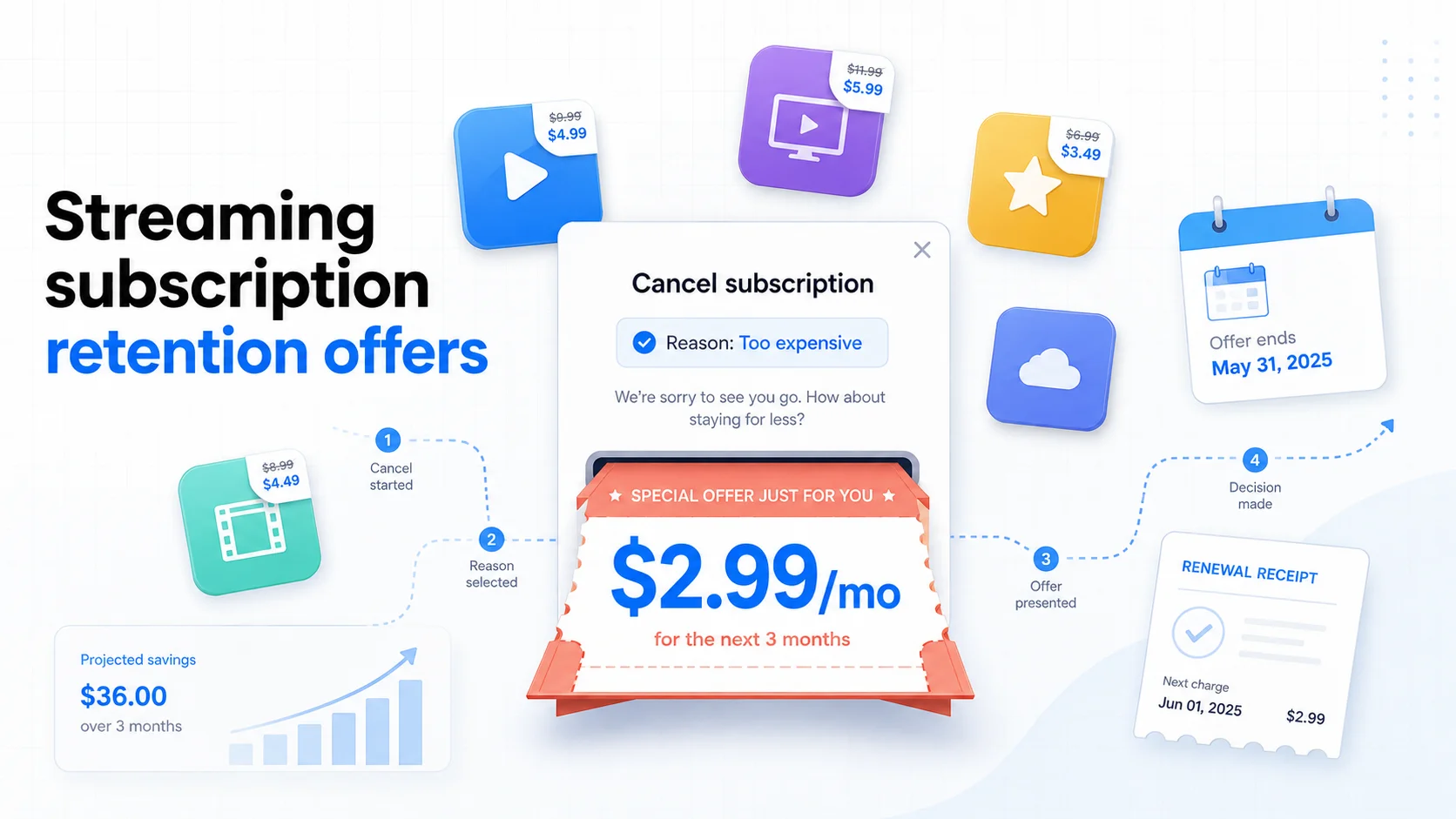
The Subscription Retention Offer Playbook: What Streaming Services Actually Offer When You Try to Cancel (2026 Edition)
Hulu, Peacock, Max, Apple TV+, Disney+, Paramount+, YouTube Premium, and Spotify all show retention discounts inside their cancellation flow. Netflix and Amazon Prime Video do not. Here is the 2026 playbook for triggering the best offer, when to accept it, and how to chain offers into a 6-month rotation.
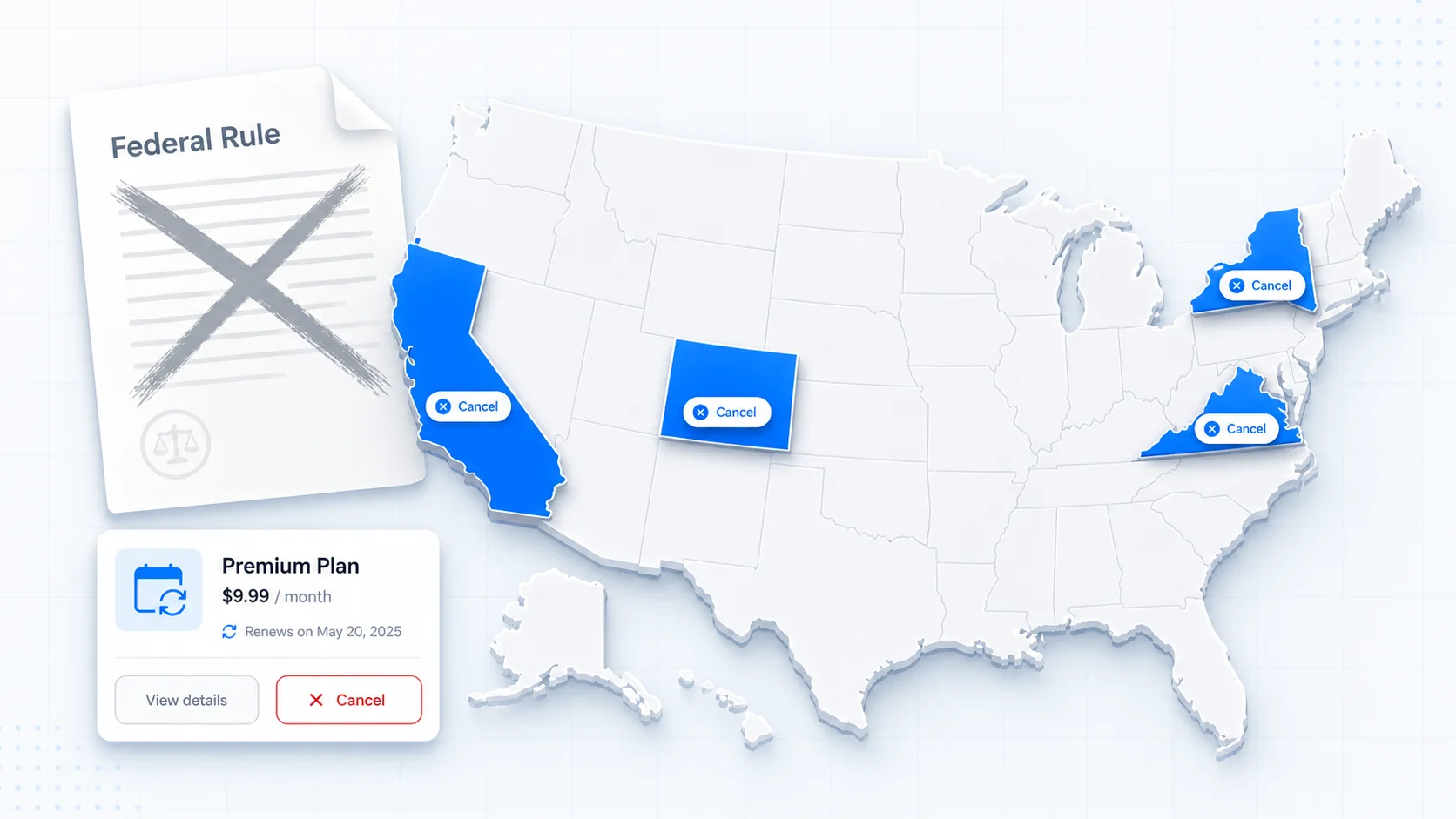
Click-to-Cancel Died Federally. Your State May Still Have Your Back: The 2026 Auto-Renewal Map
A federal court killed the FTC's national Click-to-Cancel rule, but California, New York, Colorado, and Virginia all passed their own auto-renewal laws that are in force or arriving in 2026. Here is the state-by-state map of what protections you actually have, how to tell which one covers you, and how to use those rights to cancel a subscription that will not let go.
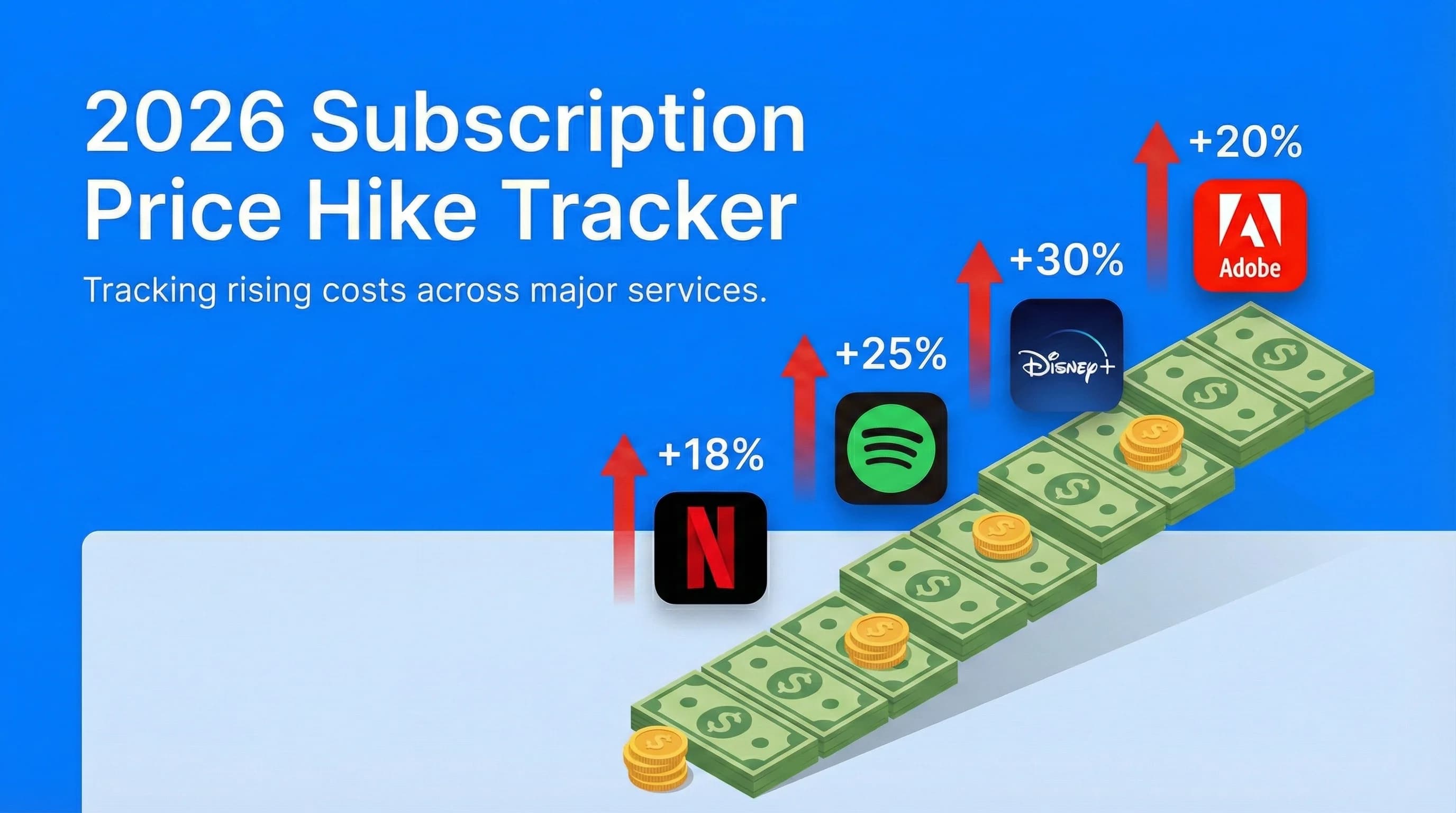
2026 Subscription Price Hike Tracker: Every Service That Raised Prices This Year
Netflix, Spotify, Disney+, Adobe, and other recurring services have all become more expensive heading into 2026. This tracker summarizes confirmed major subscription price increases, when they happened, and how much more you're paying.