The Subscriptions Hiding on Your Phone Bill: A Carrier Perk Audit (Verizon, T-Mobile, AT&T)
Table of Contents
A streaming subscription billed by your phone carrier is invisible to every audit method that works on everything else, because your bank only ever sees one charge from Verizon. There is no separate merchant, no app-store receipt, no renewal email from Netflix. The perk renews inside a bill you glance at for the total and never read line by line.
That is a gap in our own advice. The bank statement audit and the billing descriptor decoder both work by finding a charge and identifying the merchant behind it, and carrier perks defeat that method by design: the merchant is your carrier, the descriptor is correct, and the charge is one you fully expect. Our ten-hiding-places checklist at least tells you to open the itemised phone bill, but it stops there. This post is what to do once you are inside it: a price card for the three US carriers, the overlaps the carriers document themselves, and a break-even test that decides whether a perk is a discount or a new subscription you did not know you had.
Last reviewed: September 15, 2026. Every perk price below was taken from the carrier's own support page, and every retail comparison from the provider's own price card — Apple, Disney, Hulu, HBO Max — not from a comparison site. Prices are US, per month, before tax. Announced increases are flagged with the effective date the carrier or provider published.
Why Every Audit Method Misses Them
Run the four standard sweeps against a carrier perk and watch each one fail:
- Bank or card statement. One line: your carrier, one total. The $13 streaming perk inside it has no separate presence.
- Card-issuer subscription manager. Same problem. It sees a recurring merchant called Verizon and correctly labels it as your phone bill.
- App-store subscription list. Nothing. The perk was never bought through Apple or Google.
- Email receipt search. Your renewal receipt is the carrier invoice, filed under a subject line about your wireless account.
The only place a carrier perk exists is inside the carrier's own account area, on a screen most people open once, at signup. Verizon confirms the mechanics plainly on its own support pages: the perk charge "appears on your mobile bill" or your Fios bill, and "the perk renews automatically each month until you cancel it." That is a textbook recurring subscription with a renewal date. It just lives on a different rail from every other subscription you own, which is why it outlives every sweep you run on the others.
What Each Carrier Actually Bills
The three carriers use three different structures, and the difference matters more than the prices.
Verizon sells perks as separate priced line items, one of each per eligible line, on Simplicity, Unlimited Ultimate, Unlimited Plus and Unlimited Welcome, plus home internet and Fios accounts. A four-line household with home internet can be carrying five or six of these at once, each on its own line, each renewing independently.
T-Mobile mostly folds streaming into the plan price. Its streaming page puts Netflix Standard with ads on an Experience More or Experience Beyond line, and Hulu (With Ads) on a qualifying Experience Beyond line, with no separate charge to find. Apple TV is the exception: a discounted line item at $3 per month, or a six-month trial that, in T-Mobile's words, "renews at $12.99/month unless canceled." That quoted figure is worth a second look — Apple's own page lists Apple TV at $14.99 a month after the increase Apple announced on August 28, 2026, so the number T-Mobile is comparing against is the old one. Check what the line actually bills you, not what the offer page says it is worth.
AT&T currently includes no streaming at all. Its published lineup — Value 2.0, Extra 2.0, Premium 2.0 and Elite 2.0 — is sold on data, hotspot and international allowances. The audit action for AT&T customers runs the other way: HBO Max's own provider list still names older AT&T plans, including Unlimited Elite, Unlimited Plus and several Internet tiers, as including HBO Max Standard. If you are on one of those legacy plans and also paying $18.49 a month for HBO Max Standard directly, that is $221.88 a year for something your plan already carries.
Here is the Verizon perk card, with each retail figure checked against the provider's own page rather than the carrier's marketing number:
| Verizon perk | On the bill | Provider's own retail price | Monthly gap |
|---|---|---|---|
| Disney+, Hulu, ESPN+ (With Ads) | $10, rising to $12 on Sept 17, 2026 | $21.99 (Disney+, Hulu, ESPN Select bundle) | $11.99, then $9.99 |
| Netflix Standard with Ads + HBO Max Basic with Ads | $13 | $8.99 + $10.99 = $19.98 | $6.98 |
| Apple One Individual | $15 | $21.95 (Verizon's page still says "a $19.95/month value") | $6.95 |
| Apple One Family | $23 since Sept 1, 2026 (was $20) | $27.95 | $4.95 |
| Apple Music Family | $13 since Sept 1, 2026 (was $10) | $19.99 | $6.99 |
| YouTube Premium | $12 | $15.99 | $3.99 |
| FOX One | $15 | Verizon states a $4.99 saving | $4.99 |
Two things stand out. First, the gaps are consistent and modest: four to seven dollars a month on most perks, which is a genuine discount but not a category-changing one. Second, the perk prices move. Verizon raised the Apple One Family and Apple Music Family perks on September 1, and the Disney perk goes from $10 to $12 on September 17 — a 20% increase on a line item most subscribers have never looked at. If you want to act inside that window, the grace period between a price-hike notice and your next bill works the same way here as it does for a direct subscription.
A third thing only shows up if you check both sides of the comparison. Verizon's Apple One perk page still describes the perk as "a $19.95/month value", while Apple's own page has listed Apple One Individual at $21.95 since the rise Apple announced on August 28, 2026. The perk quietly got two dollars better and the carrier's own savings figure never moved. That is the general rule for this whole audit: price a perk against the provider's page, never against the carrier's marketing number, because the two drift apart in both directions.
The Double-Pay Overlaps, Documented
This is the part worth reading twice. When you add a perk for something you already subscribe to, the carrier does not always take over the existing subscription. Sometimes it pauses it, sometimes it replaces it, and sometimes it does nothing at all and leaves you paying two providers for the same service. The rules are not consistent, not intuitive, and are all written down on the carriers' own FAQ pages.
| What you already pay for | What the perk does to it | Result |
|---|---|---|
| Apple One Individual, billed by Apple, same Apple ID | Verizon: "the original subscription suspends and resumes when the subscription through Verizon is canceled" | Clean handover |
| Apple One Family billed by Apple, plus the Verizon Individual perk | Verizon: "the original subscription continues and runs at the same time as the Apple One perk subscription. To cancel the original subscription, contact Apple" | Both bills run. $27.95 + $15 |
| Apple One Premier billed by Apple, plus any Verizon Apple One perk | Verizon: "the original subscription continues and runs at the same times as the subscription through Verizon" | Both bills run. $39.95 + $15 |
| iCloud+ 200 GB, plus the Apple One Individual perk (50 GB) | Verizon: Apple cancels the storage only "if the storage amount is less than or equal to the amount of the Verizon subscription perk" | Larger tier survives. You pay for both |
| Disney bundle bought directly from Disney, same email address | Verizon: "your existing subscription(s) is automatically paused" | Clean handover, only if the emails match |
| Disney bundle bought through Apple, Google or Amazon | Verizon: the perk "doesn't automatically replace or pause the previous subscription(s)… You're still billed for your existing subscription(s) through the third party until you take the steps" | Both bills run until you cancel in the store |
| An annual Hulu subscription, plus the Verizon Disney perk | Verizon: annual subscribers "must cancel their Hulu subscription in order to complete Hulu account setup," and cancellation "will forfeit the remainder of the annual subscription period" | You lose the unused months, no refund |
| An annual FOX One subscription, plus the FOX One perk on the same email | Verizon: "the original subscription will continue to its end date. You will then have 2 FOX One subscriptions" | Both bills run for the rest of the year |
| An existing Netflix account linked to T-Mobile Netflix On Us | T-Mobile: "it may take 1-2 bill cycles during which time you will continue to be charged separately" | Temporary overlap, expected, resolves itself |
The pattern is that carrier billing can only pause or replace a subscription it can reach. A subscription bought from the provider directly, on the same email address, it can reach. A subscription bought inside an app store, or on a different address, or on a higher tier than the perk offers, it cannot. Everything in the second category keeps billing until you go and stop it yourself. If you find a live pair, our guide to deciding which duplicate to cancel without losing your library covers the tie-breakers — term, library ownership and which side can actually refund you.
The Break-Even Test
Every carrier savings claim rests on one silent assumption: that you would have bought the entire bundle at retail. Verizon's "$21.99 value" for the Disney perk is only a $21.99 value to someone who would genuinely have paid Disney $21.99 a month. For anyone else it is arithmetic about a purchase they were never going to make.
The honest test uses one substitution. Instead of the retail price of the bundle, use the retail price of only the parts you would pay for on their own:
- Real monthly result = (retail price of what you would actually buy) − (perk price on your bill)
- Positive, and the perk is a discount.
- Negative, and the perk is not a discount at all. It is a subscription you acquired by accident, billed somewhere you do not look.
Three illustrative households, using the September 17 Disney perk price of $12 and Disney's own published prices:
- Watches all three services. Retail comparison $21.99, perk $12. Result: $9.99 a month, $119.88 a year. The perk earns its place.
- Watches Hulu, ignores ESPN+. The honest comparison is Disney's own Disney+ and Hulu duo bundle at $12.99. Result: $0.99 a month, $11.88 a year. Technically a saving, practically a rounding error — and it disappears entirely the next time either price moves.
- Never activated it. Retail comparison $0, perk $12. Result: minus $144 a year, and nothing on any statement will ever tell you.
The same substitution is what makes or breaks any multi-service bundle, which is why our bundle ROI calculator asks for usage before it asks for prices. Carrier perks are simply the version of that question where you cannot see the answer on a bank statement.
The Lock-In Math Nobody Prices In
Here is what no perk comparison mentions: the saving exists only while the line does. Verizon states it directly — "if you cancel your qualifying plan or account then going forward the perk and its subscriptions are canceled." Cancel the phone line and the streaming goes with it.
That makes a perk's real value conditional on staying with the carrier, so the switching decision has to be priced into the perk, not the other way round:
- Net monthly value = (what the perk saves you) − (what your plan costs above the plan you would otherwise be on)
Worked as an illustration rather than a measurement, because plan prices swing with line count, autopay and promotions: if your current line costs $15 a month more than the plan you would switch to, a $6.98 Netflix and HBO Max perk does not make that line cheaper. It reduces a $15 premium to an $8.02 premium. That is worth knowing, and it is not a saving. Plug your own two numbers in before you let a perk decide where you buy phone service.
The exit is also asymmetric between carriers, in opposite directions, and both failure modes cost money:
- Verizon. The perk dies with the line. If you had a direct subscription that Verizon paused, it resumes when the perk is cancelled — at whatever the retail price is that day, not the price you were paying before.
- T-Mobile. The opposite. On a linked Netflix account, "terminating the qualifying line(s) will not automatically cancel your Netflix membership, and Netflix will automatically resume charging your existing payment method that they have on file." Leave T-Mobile and a Netflix bill you had forgotten about restarts on a card, silently.
So the week you change carriers is also the week to check both lists: what stopped that you wanted, and what started that you did not.
Four Fine-Print Rules That Cost Money
These come from the carriers' own FAQ text, and they are not consistent even between two perks on the same bill.
1. The 90-day activation cliff
Verizon requires you to activate at least one of the perk's subscriptions within 90 days of buying it, "or the perk automatically cancels." Buying a perk and never setting it up therefore costs you up to three months of charges, after which the line quietly disappears from your bill. Nothing on any card statement marks either event.
2. Proration is per-perk, not per-carrier
Two perks, same bill, opposite rules. On the Disney perk, Verizon says the charge for the month you cancel "isn't refunded or prorated," and that a perk auto-cancelled for non-activation is charged in full: "the perk charge for that month isn't prorated. You're charged the full perk price." On the Apple One perk, the same company says "the monthly perk charge is prorated," with a refund for the remaining days. Practical consequence: remove a non-prorated perk immediately after a bill date, and a prorated one whenever you decide.
3. Suspending a line is not the same as cancelling
Suspend the line carrying the Apple One perk and Verizon says the $15 charge is refunded. Suspend the line carrying the Disney perk and you keep access to the end of the period, after which it does not renew. If you suspend a line seasonally, that difference is worth a note in your tracker.
4. An upgrade can be a downgrade
Verizon's legacy $15 Disney perk is closed to new customers but still live for people who have it. Two documented traps sit on it. Taking the ESPN Unlimited upgrade carries Verizon's own warning: "this bundle downgrades your Disney+ Premium to Disney+ (With Ads)." And if you upgrade a tier and later remove it, "you lose that perk and swap to the Disney+, Hulu, ESPN+ (With Ads) perk for $10/month instead" — the legacy perk cannot be added back. A tier change you make for one reason can quietly reset what you are actually watching.
The 15-Minute Carrier Perk Audit
- Minutes 0–3: open the itemised bill. On Verizon, Products and plan perks, checked per line — including home internet and Fios accounts, which carry their own perks on their own invoices. On T-Mobile, your plan benefits plus any Apple TV line. On AT&T, your plan name, then HBO Max's provider page to see whether a legacy plan entitles you to something you are separately paying for.
- Minutes 3–6: write the list. Perk name, monthly charge, which line it sits on. One perk per line means a four-line account can be carrying four, added by different people at different times.
- Minutes 6–10: price what you would actually buy. Open each provider's own price page and note the retail cost of only the services you would pay for alone. Apply the break-even test above to each perk in turn.
- Minutes 10–13: hunt the mirror charge. For every perk, check the Apple and Google subscription lists, PayPal automatic payments, and the provider's own account page. This is where the overlaps in the table above turn up. Our HBO Max price and cancellation guide and the other service pages carry the current retail figures if you want them in one place.
- Minutes 13–15: decide and time it. Keep, remove or switch tier. Where the perk is not prorated, schedule the removal for just after a bill date. Then log every perk you kept in your tracker with its price and its bill date, because next month it goes back to being invisible.
One note on how we track these ourselves. SubBuddy's service database prices all 49 services at their direct retail rate, because a carrier perk price is a property of your plan, not of the service — there is no single "Verizon price" for Netflix that would be true for every reader. So a perk goes into SubBuddy the same way any subscription does: entered by hand, with the price on your bill, the renewal date, and a note saying which line it belongs to. That is also the only way it appears on the same list as everything else, given that no bank feed will ever surface it.
Sources and Scope
Scope: US consumer postpaid plans, September 2026. Prices exclude tax, and vary with line count, autopay and promotions. Business and prepaid brands follow different rules.
- Verizon: Disney+, Hulu, ESPN+ (With Ads) perk FAQs — the $10 to $12 increase effective September 17, 2026, the 90-day activation rule, the no-proration cancellation term, the third-party non-pause, and the legacy-perk downgrade warnings.
- Verizon: Netflix and HBO Max (With Ads) perk FAQs — the $13 perk price, the $8.99 and $10.99 component values, and the requirement to replace an existing HBO Max account at registration.
- Verizon: Apple One perk FAQs — perk pricing, the September 1 Apple perk increases, the prorated cancellation term, and the exact list of which existing Apple subscriptions suspend and which keep billing.
- Verizon: YouTube Premium perk FAQs — the $12 perk against a stated $15.99 retail value.
- Verizon: FOX One perk FAQs — the $15 perk price, Verizon's stated $4.99 saving, and the annual-subscription case that leaves you with two FOX One subscriptions.
- T-Mobile: streaming included with your plan — Netflix Standard with ads on Experience More and Experience Beyond, Hulu (With Ads) on Experience Beyond.
- T-Mobile: Netflix On Us — qualifying plans, the one-to-two-cycle billing overlap, and Netflix resuming charges on the card on file when the line ends.
- T-Mobile: Apple TV offer FAQs — the $3 per month price, the $12.99 retail rate, and the trial that auto-renews at full price.
- HBO Max: which providers include HBO Max — the list naming legacy AT&T Unlimited and Internet plans as including HBO Max Standard.
- AT&T: wireless plans — the current Value, Extra, Premium and Elite 2.0 lineup, described entirely in data and international terms, with no streaming inclusion.
- Apple One, Apple Music and Apple TV — the $21.95, $27.95, $39.95, $19.99 and $14.99 retail figures used above.
- Disney: Disney+, Hulu, ESPN bundle prices and HBO Max plans — the $21.99 trio, the $12.99 duo, and the $10.99 and $18.49 HBO Max prices.
Alex Coca
Alex Coca is the independent developer behind SubBuddy. He researches subscription billing, cancellation patterns, and recurring-spend workflows by building the product and reviewing real subscription audits from users and his own accounts.
Put the Perks on the Same List as Everything Else
A carrier perk is a subscription with a renewal date and a price, even though it never leaves your phone bill. Record each one in SubBuddy with its line, its price and its next bill date, so it is audited alongside the charges your bank can actually see.
Track My Carrier PerksRelated Articles
How to Find Forgotten Subscriptions: The 10 Places They Hide
Forgotten subscriptions rarely sit in one obvious list. Here are the ten places recurring charges hide — app stores, statements, PayPal, Amazon, carrier bills, old emails — and a 30-minute sweep to surface every one.
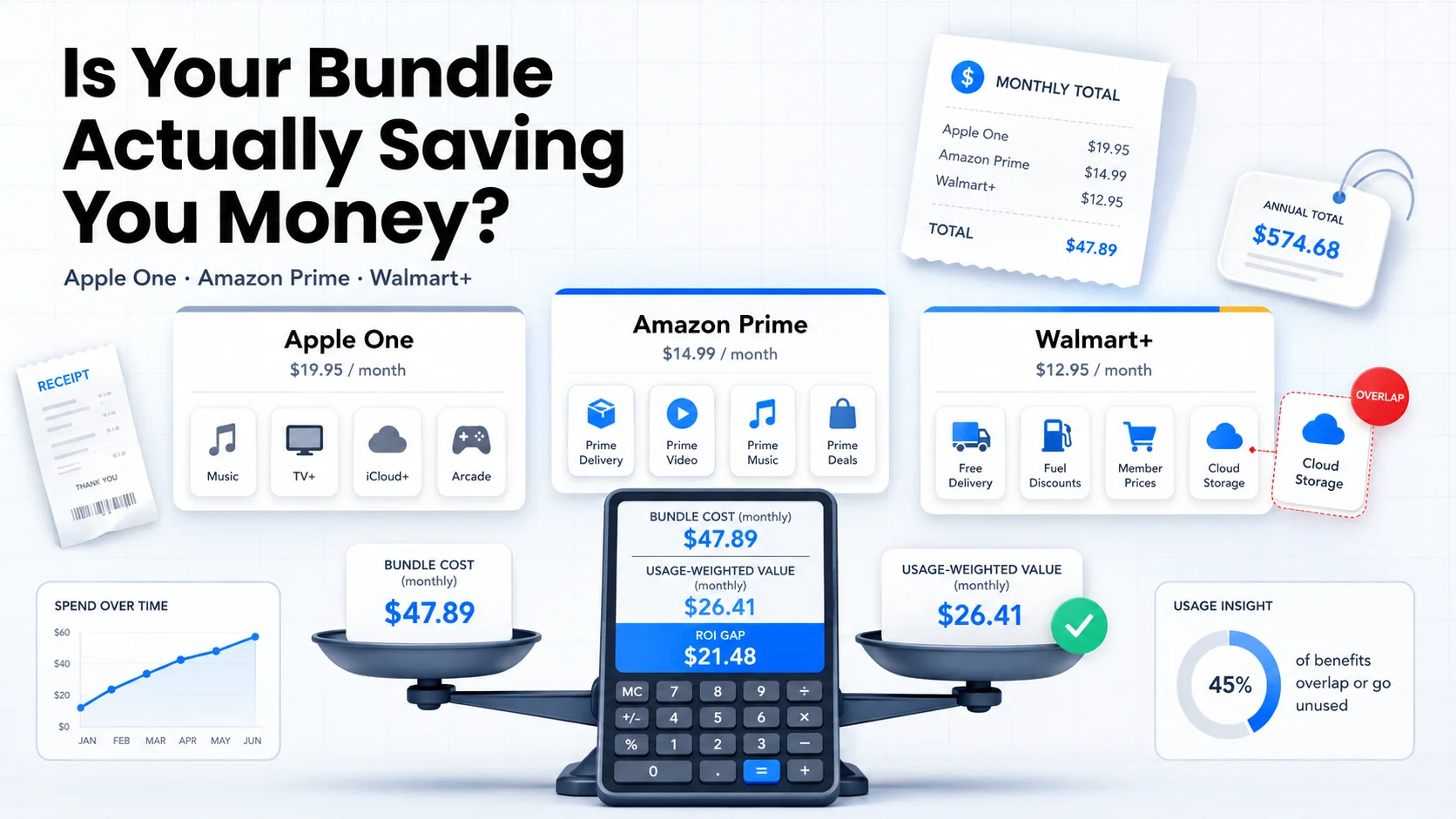
Is Your Bundle Actually Saving You Money? The 2026 ROI Calculator for Apple One, Amazon Prime, and Walmart+
Most people buy subscription bundles assuming they save money but never run the math. This step-by-step framework breaks down Apple One, Amazon Prime, and Walmart+ by what you actually use in May 2026 and gives you a clear decision rule for whether your bundle is a deal, a breakeven, or a quiet money drain.
How to Audit Your Bank Statement and Find Hidden Subscriptions in 30 Minutes
Stop letting forgotten subscriptions drain your bank account. This step-by-step guide shows you exactly how to audit your statements, identify hidden charges, and reclaim your money, all in half an hour.